La Digue – A Step Back in Time

It’s 7am on a Monday morning, when I set off to the island’s one and only open Market. The air is refreshingly cool carrying a hint of the sun’s impending warmth. In the background, I listen to the enchanting symphony of birds greeting the new day. 

As I pedal down the main road, I watch locals heading to work and kids whizz by on their bicycles with their school bags neatly tucked into the rear baskets. Everyone seems relaxed and cheerful, as if nothing matters. Life is so simple here in la Digue – no morning rush or traffic jams.
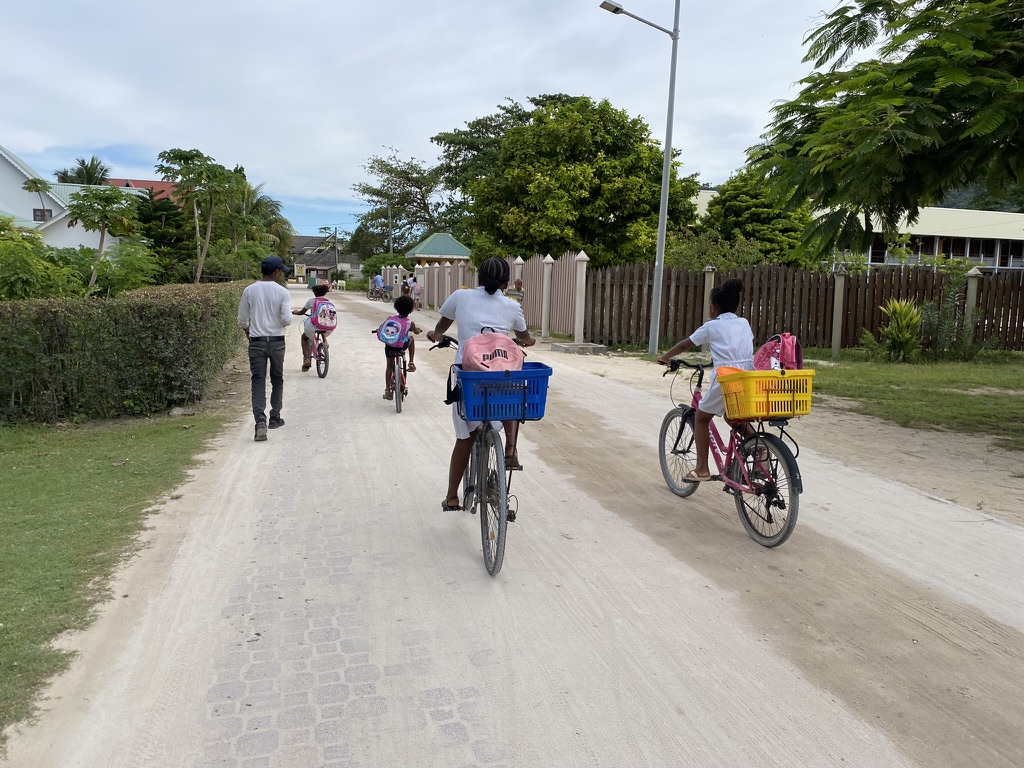
La Digue – Kids heading to school on their bicycles in the early hours of the day

La Digue, the Seychelles’ third most inhabited island, is considered a marvel and a perfect destination for escapism. Its relaxed lifestyle, natural beauty and stunning beaches make it an ideal retreat for those seeking a break from the outside world.

The island’s small size makes it perfect for exploration by foot or bicycle – the main modes of transportation, along with a handful golf carts for those who prefer not to walk or ride a bike. 
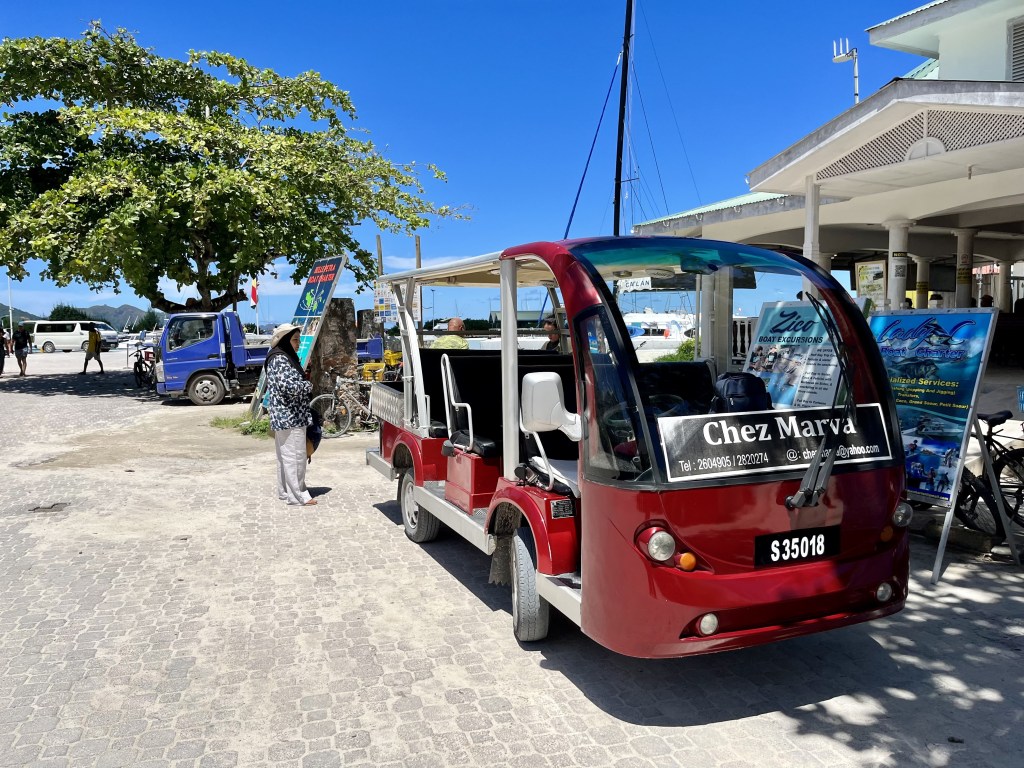
Golf Carts- An alternative mode of transportation in La Digue

It has one road that runs most of the way around the island’s west coast, and a small village situated next to the main boat jetty at La Passe. The rest of the island is mostly beaches and green hills dotted with charming Creole-style houses.

We arrive to La Digue around 18:30 by ferry. The trip from Mahé took around 1 hour and 45 minutes, including a short stop at Prasline. From here, we hop on the back of a big truck with seats, with a Seychellois family who are spending their weekend at the island and are kind enough to let us ride with them, as we haven’t booked transport in advance and options at the ferry station are limited. The ride is a bit bumpy, but we eventually made it after half an hour. As it’s already pitch dark, we decide to stay in for the night. 

The next day, we head to Anse Source d’Argent, famous for being one of the most photographed beaches on the planet. As we approach, we are greeted by the sight of towering granite boulders, sculpted by nature and time into smooth and beautiful shapes dotted along a stretch of powdery white sand, set against emerald-green vegetation. The cotton-like sand merges seamlessly into sparkling crystal clear waters, with varying shades of blue and turquoise,  inviting us for a swim to cool down from the heat of the day.
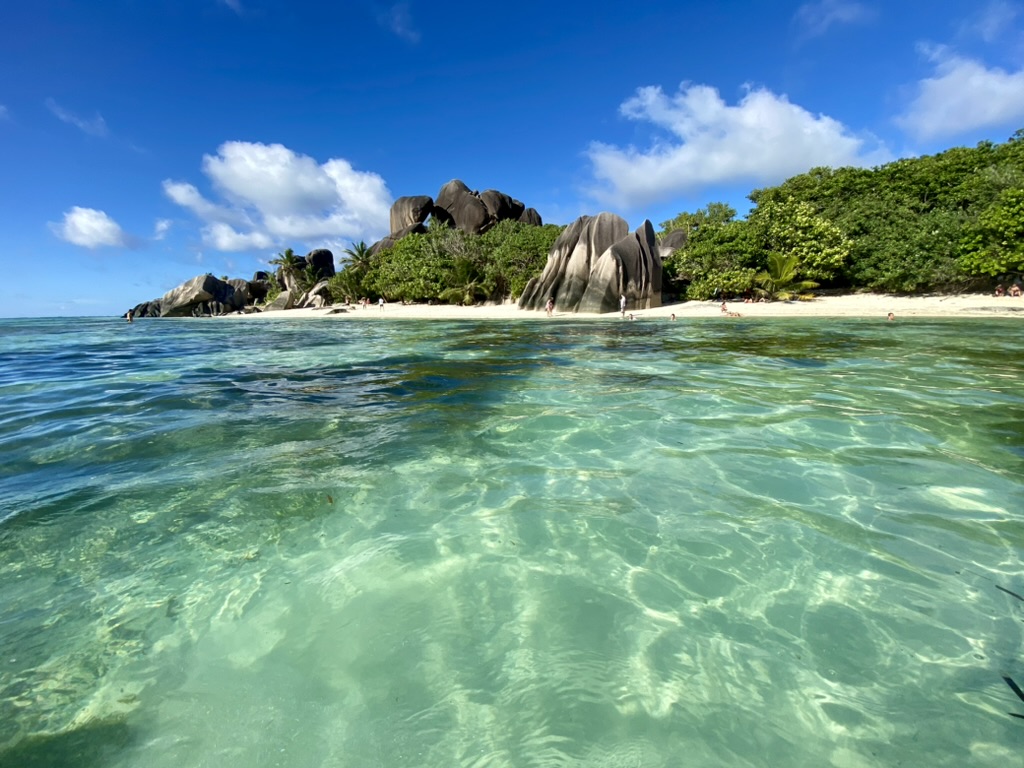
Anse Source d’Argent

We sit under the shade of a Takamaka tree to escape the scorching midday heat, whilst enjoying fresh pineapple juices from a quaint little shack that sells drinks and snacks. It’s incredibly refreshing! Later in the afternoon, after a long swim and some snorkelling, we wander along a stretch of beautiful small beaches that form Anse Source d’Argent. The further we walk, the more beautiful the scenery gets. On the way back, we are treated to one of the most beautiful sunsets – a mosaic of colours that blend together in a spectacular display for its audience.
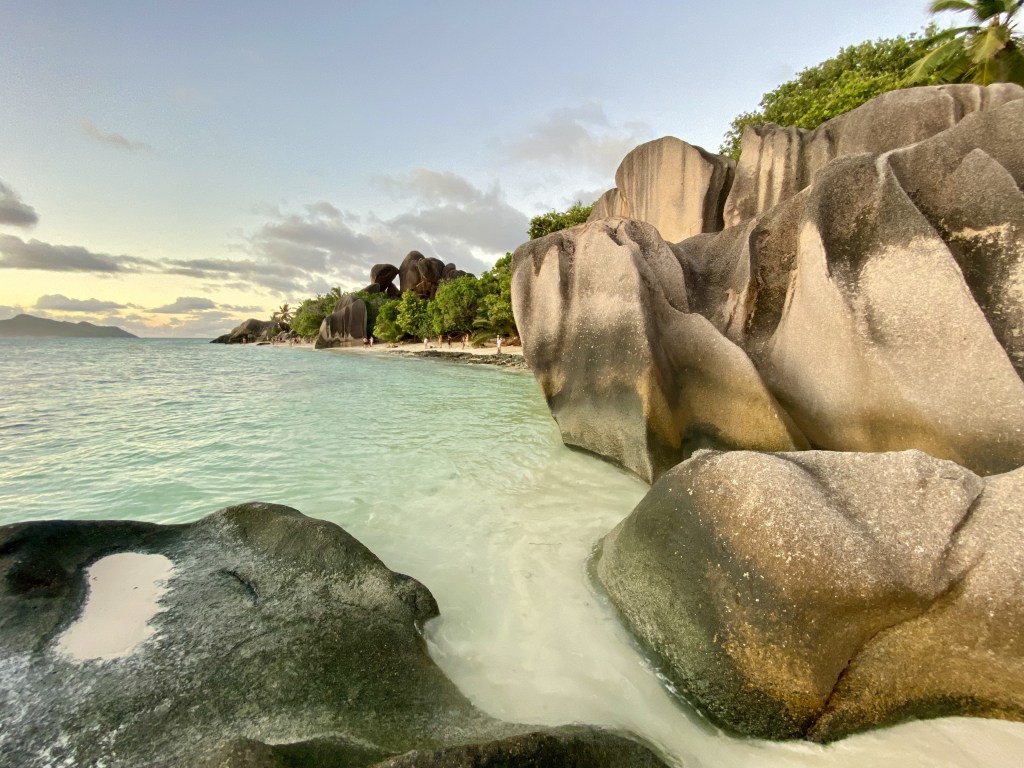
Granite bolders at Anse Source d’Argent

The following day, I set off on my bike at 7:30 in the morning with the hope of getting some fresh fruits from the local market. I didn’t realise it’s Sunday and everything is closed except for restaurants and a couple of supermarkets that open till noon. I stop at the Fish Trap restaurant for a coffee. They have a stunning view over the jetty. With soft music playing in the background, I slowly sip my steaming black coffee, savouring the sound of the waves gently hitting the shore, the freshness of the morning air and the view of fishermen’s boats dotting the sparkling sea. 
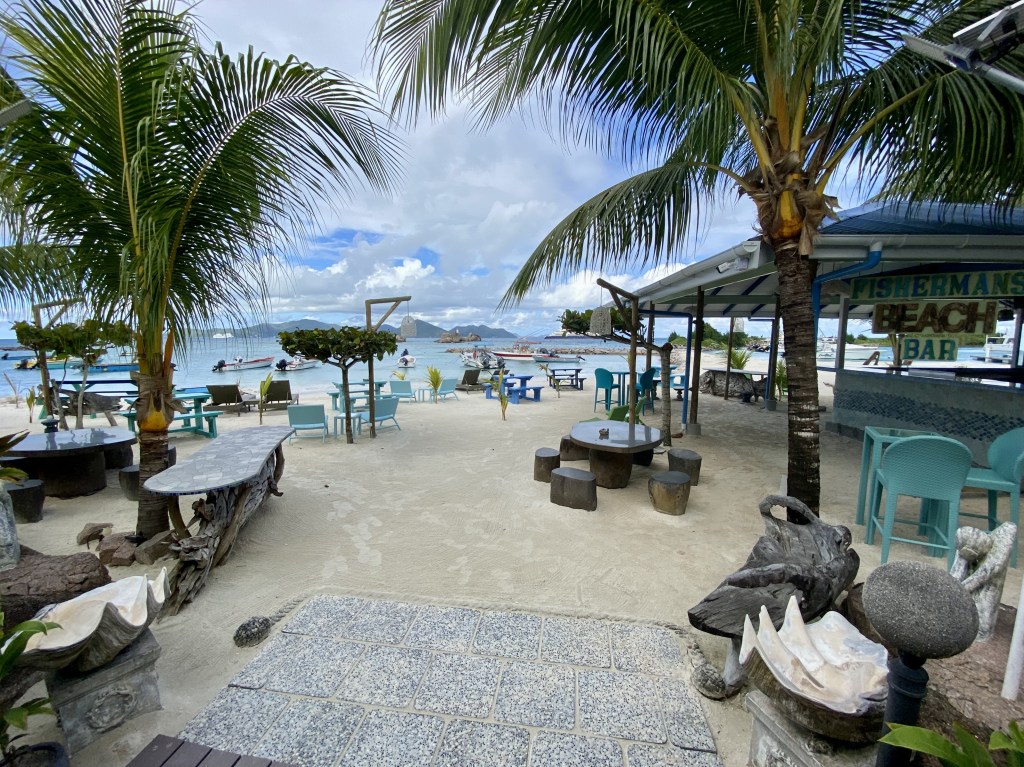
Boat Jetty at La Passe – View from the Fish Trap restaurant

In the afternoon, we hop into a club cart and head to Anse Severe, in the northwest coast of the island, not too far from La Passe – the island’s main village. As we arrive, we watch this beautiful stretch of soft white sand beach with clear turquoise waters, framed by stands of Takamaka trees. Unlike the tranquil Anse Source d’Argent, Anse Severe feels livelier with its small shacks and stalls selling fresh juices and platters of tropical fruits. As the day winds down, the sky transforms into a vibrant tapestry of orange, pink, and purple hues dotted with clouds, providing a mesmerising view and a beautiful memory to end the day.
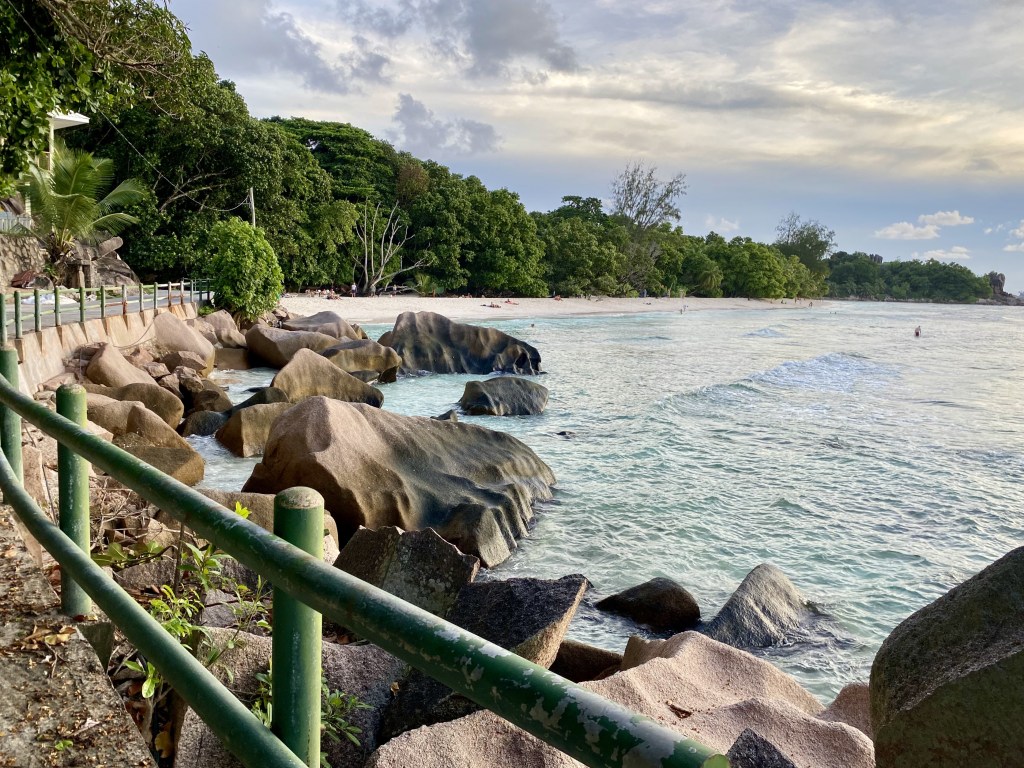
Anse Severe in the northwest coast of La Digue

The next morning, after finally getting some fruits from the local market, we go on a boat trip with Belle Petra to Grande Soeur, Petite Soeur and Felicite islands. We stop at each one for snorkelling and swimming. In Petite Soeur, we are greeted by a turtle who wants to swim with us. The waters are so clear, which give us a beautiful view of the colourful fish and underwater world. After a morning of snorkelling and swimming, we head back to shore. Greeted by heavy rains, we quickly take a club cart to Le Nautique restaurant for lunch.
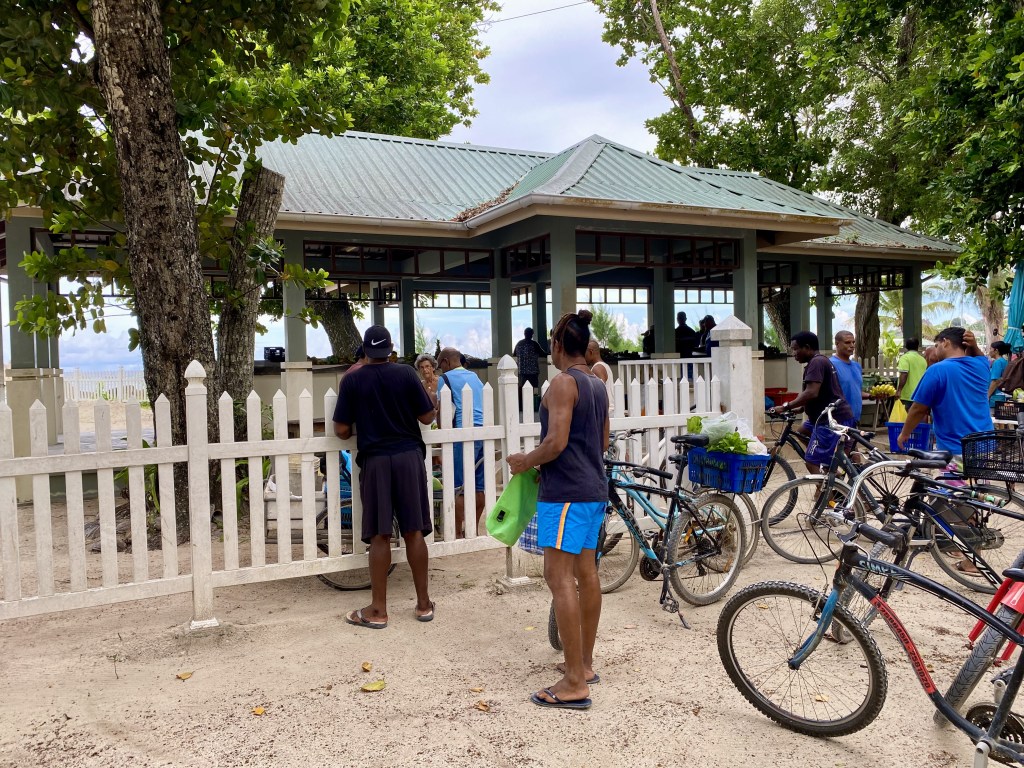
Locals at La Digue’s market in the early hours of the day

In the afternoon, my sister and I take our bikes and head to the east side of the island towards Grand Anse and Petite Anse. The ride feels very tropical, going up and down a narrow road covered by lush vegetation on both sides. Parts of it are quite steep, so we get off our bikes and walk as most people seem to be doing. An hour later, we arrive to Grand Anse, where we park our bicycles and walk for a couple of minutes through a narrow path to be greeted by beautiful turquoise and blue waters and powdery white sand. The waves at Grande Anse are very strong and it’s not recommended to swim here at this time of the year due to the strong currents. It is, however, perfect for relaxing and switching off, as it’s completely isolated and all one can do here is listen to the sound of waves crushing against the shore. 
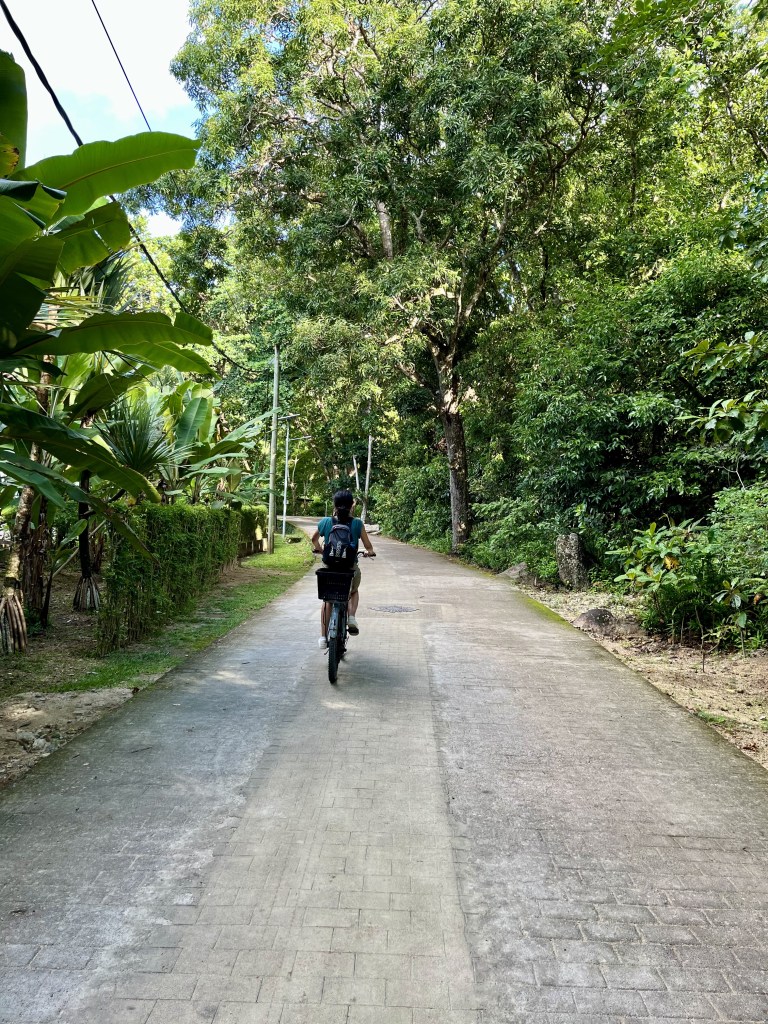
Cycling towards Grande Anse

From Grande Anse, we walk for 15 minutes up and down a trail through a tropical forest. Towards the end, we find ourselves on top of a hill. As we slowly go down a rocky path, a hidden gem gradually reveals itself to us, until we are faced with the most tranquil and serene beach we’ve come across so far on this island. Petite Anse is a secluded beach with fine white sands set against a dense tropical foliage. Like its adjacent neighbour, the waves here are quite strong, and it’s not recommended to swim during this time of the year. Despite this, the unspoilt natural beauty and seclusion of this beach makes it a perfect place for unwinding.
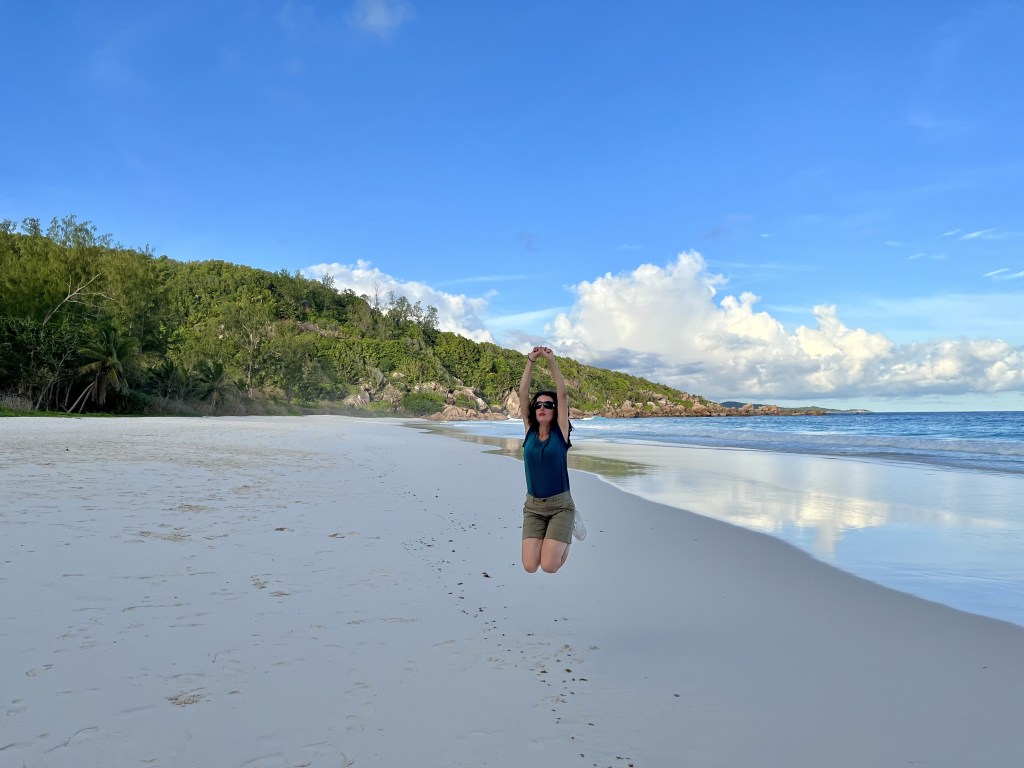
Petite Anse – If you can’t swim, you can certainly jump of happniess!

We leave this gem with a heavy heart, as it’s almost sunset and need to ride back before it gets too dark since parts of the road don’t have any lights. It’s a lot easier to ride back as most of the road is flat or downhill. As we pedal away, we watch the sky turning into a blanket of orange and purple colours and listen to the birds signing and performing a symphony, as if it’s an orchestra entertaining locals and visitors alike.
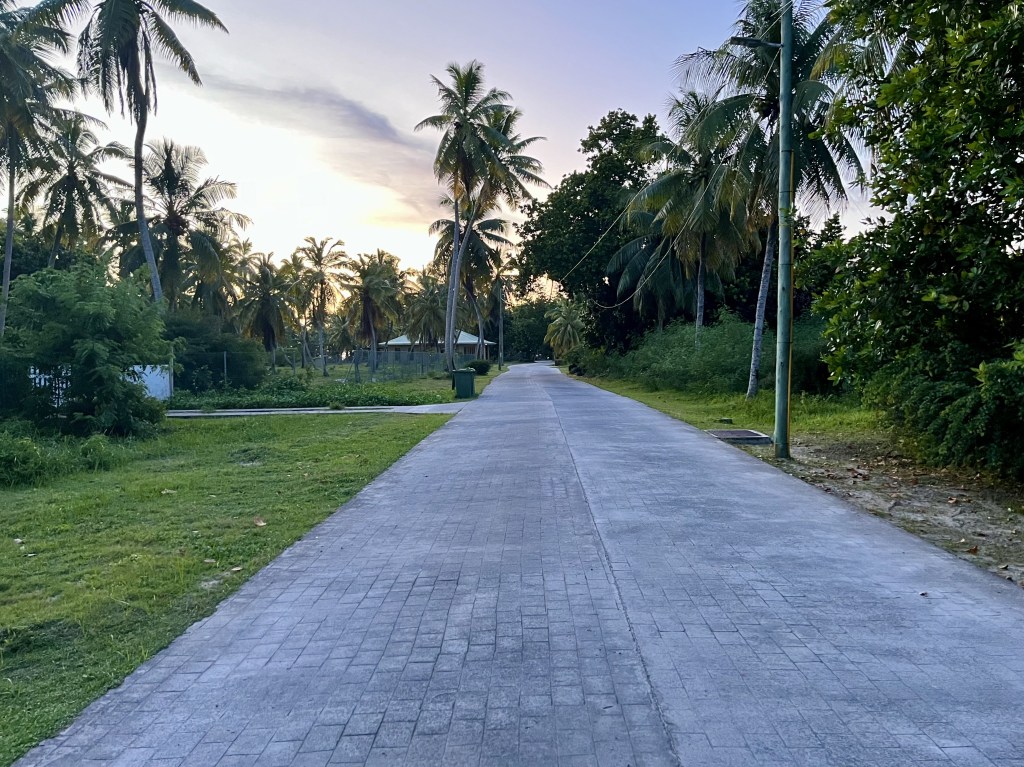
On the way back from Grande Anse

On our last day, we enjoy one last breakfast on this beautiful island and head to the ferry station to catch the 13:30 ferry. As the ferry slowly leaves the shore, we watch the island gradually disappear in the distance. It may be disappearing from our sight, but the memories of this island will certainly stay with us for life. What I realise is that La Digue is not just a natural beauty with stunning beaches; it’s also a place where life seems frozen in time. Whether by design or or not, I hope it remains a sanctuary for those seeking an escape from the hustle and bustle of modern civilisation into unspoiled natural spots. 
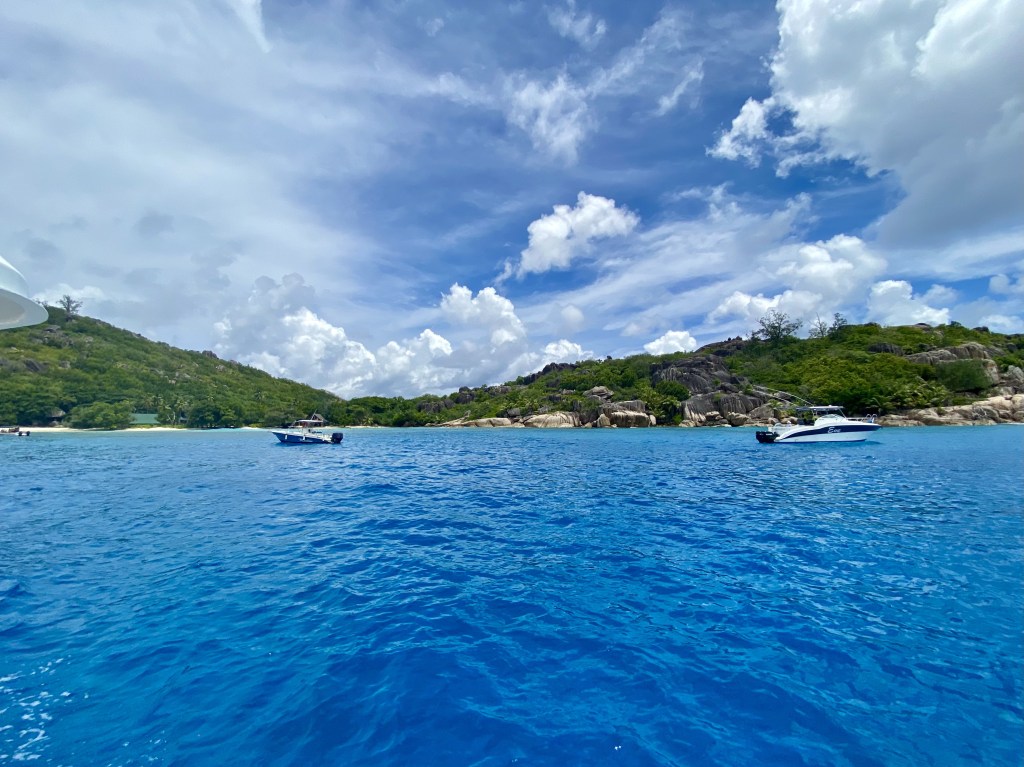
Leaving La Digue and its surrounding islands behind

London in lockdown: the City in pictures

A year since London went into its first lockdown, I decided to visit the City during rush hour to see what has become of the capital’s historic financial district.

Before the lockdown, the City was one of the busiest spots in London on weekdays. In the early mornings and late afternoons, you would find city workers, with their fancy suits and shiny shoes, flocking the numerous entrances of Bank, London Bridge and Liverpool Street stations.

Today, closed doors, deserted streets and tourist-less landmarks have become the norm. Cyclists, buses and skateboarders have replaced black cabs, corporate cars and city workers in suits. What was once known as the vibrant Square Mile has become more like a ghost town of high-rise buildings and shiny surfaces.
In these pictures, I tried to capture the spirit and show what the City looks like during lockdown on a working day.
One thing for sure, if New York is labelled as the city that never sleeps, London should be labelled as the city that never gives up. Determination, positivity and refusal to give in to the current depressing situation is what I gathered from this short afternoon in the City – a place I have strong connections with, having spent all my professional career between its offices.

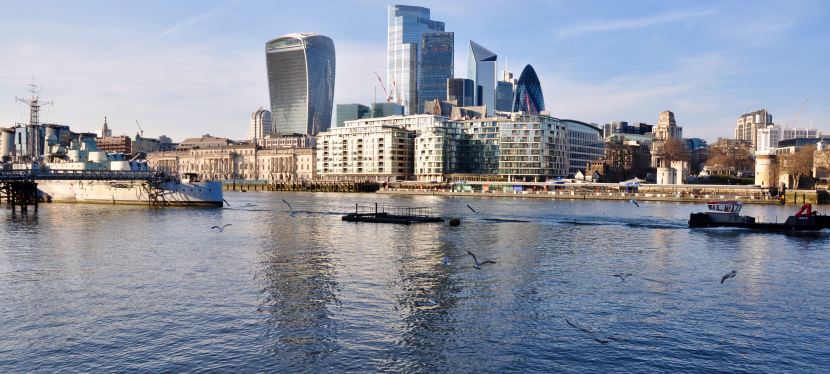
The Square Mile from a distance

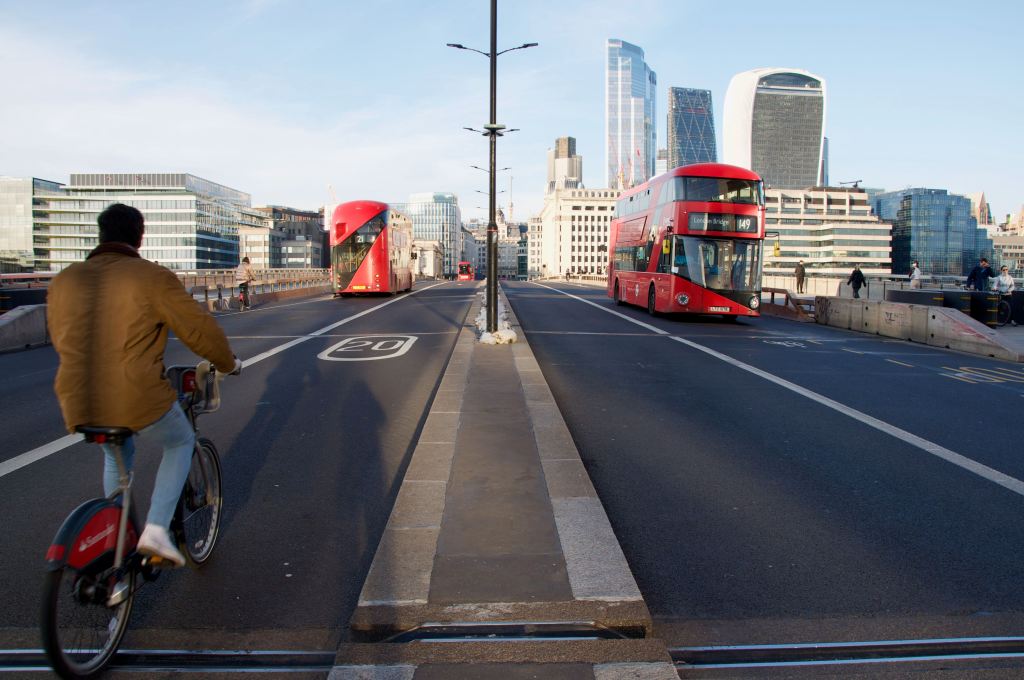
A cyclist and a couple of buses on London Bridge – instead of the pre-lockdown heavy traffic

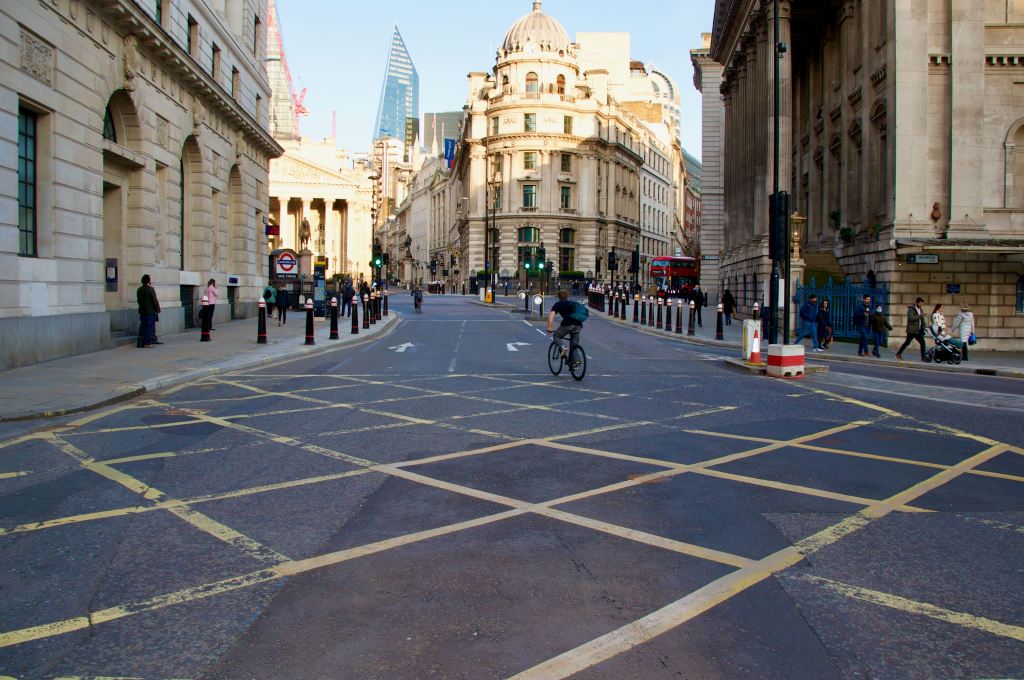
A cyclist in the empty streets near Bank station

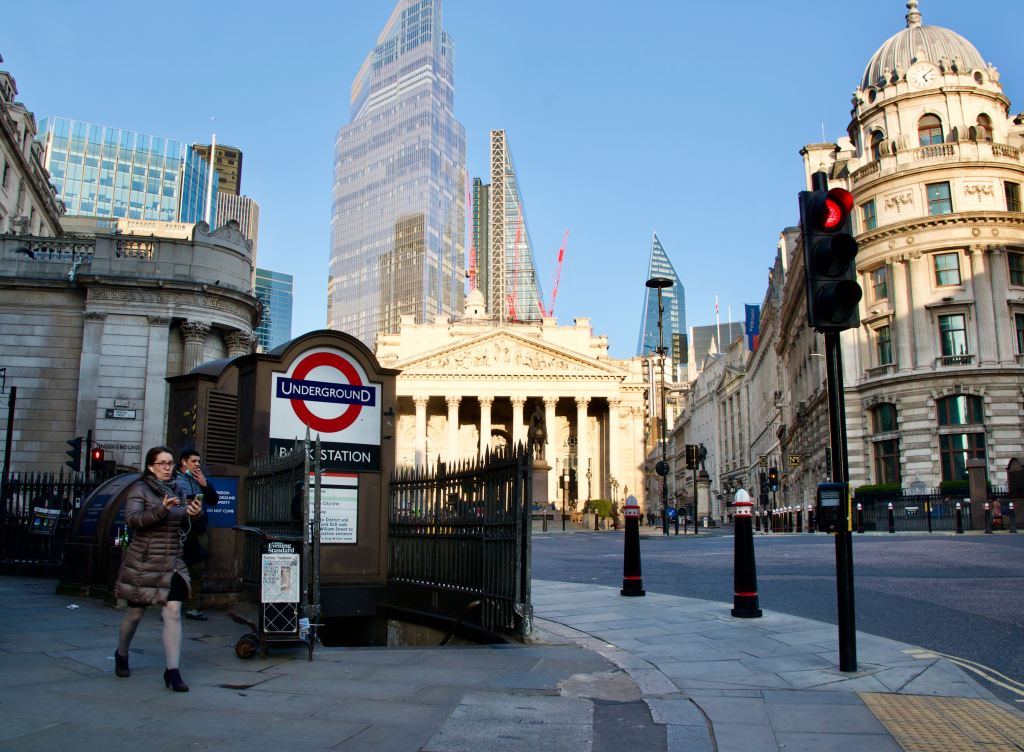
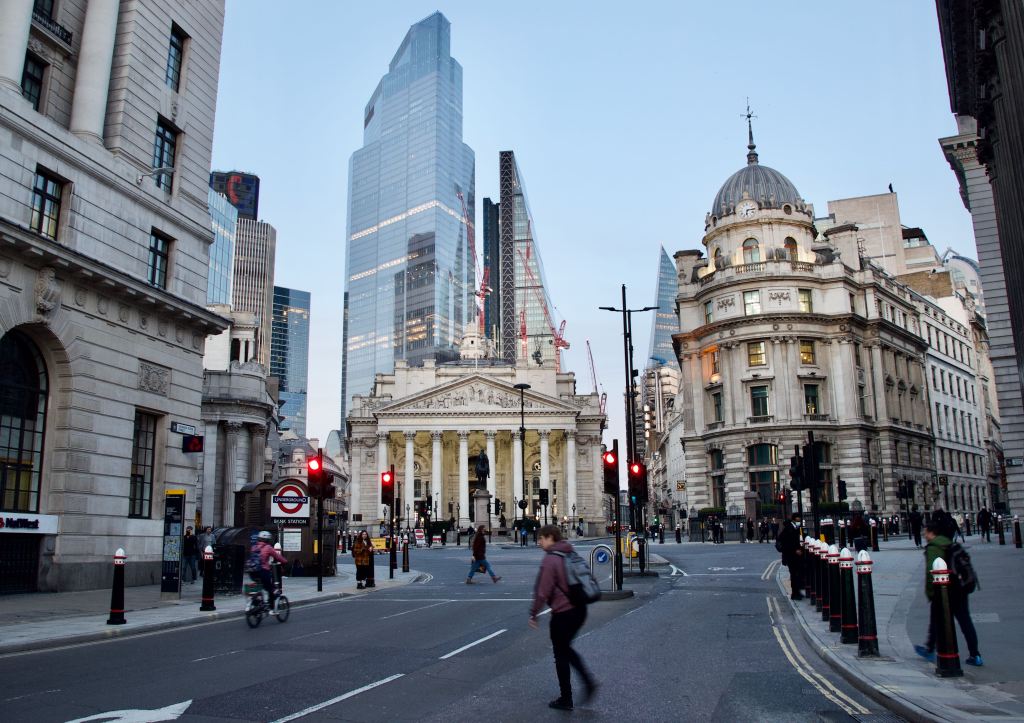
The empty entrance of Bank station that is usually packed with commuters at this time of the day

People enjoying the sun in front of the Royal Exchange

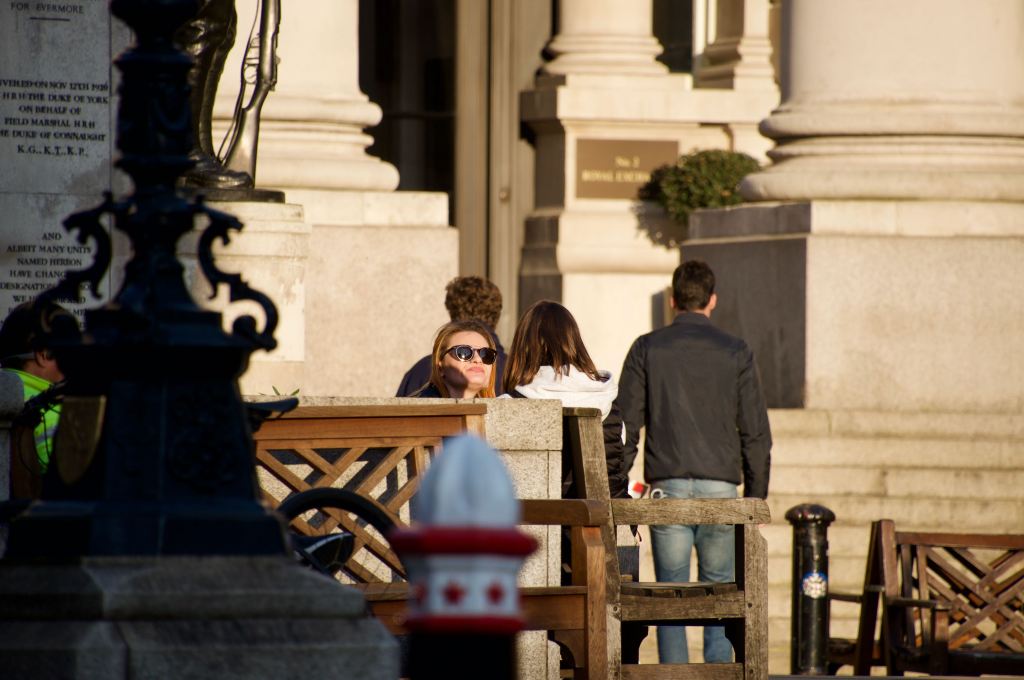
Two women enjoying the sun in front of the Royal Exchange

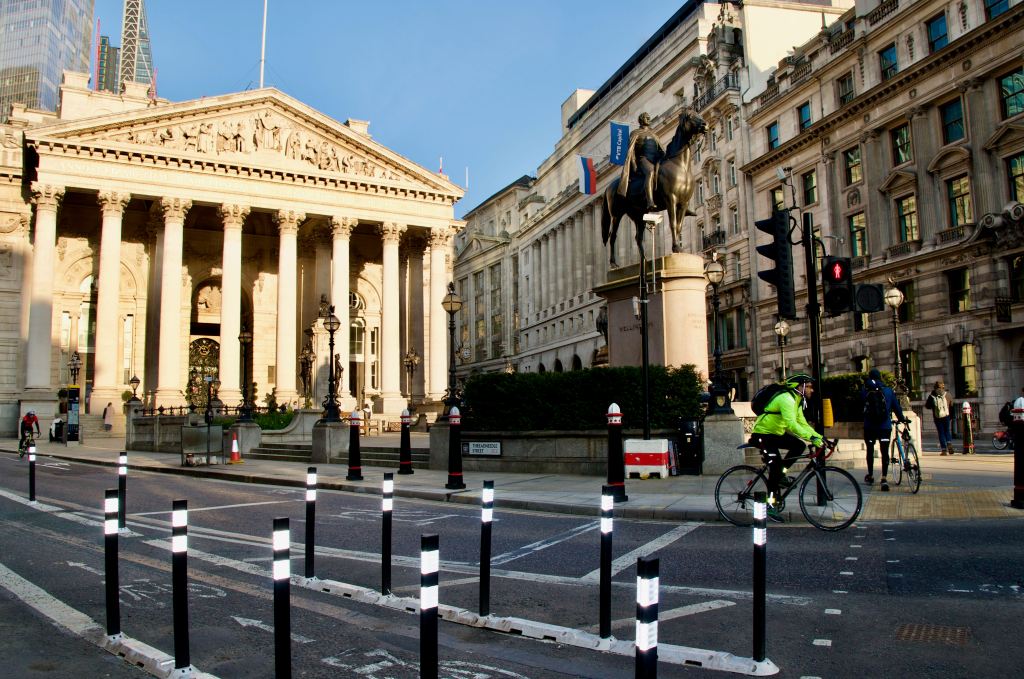
Cyclists in front of the Royal Exchange

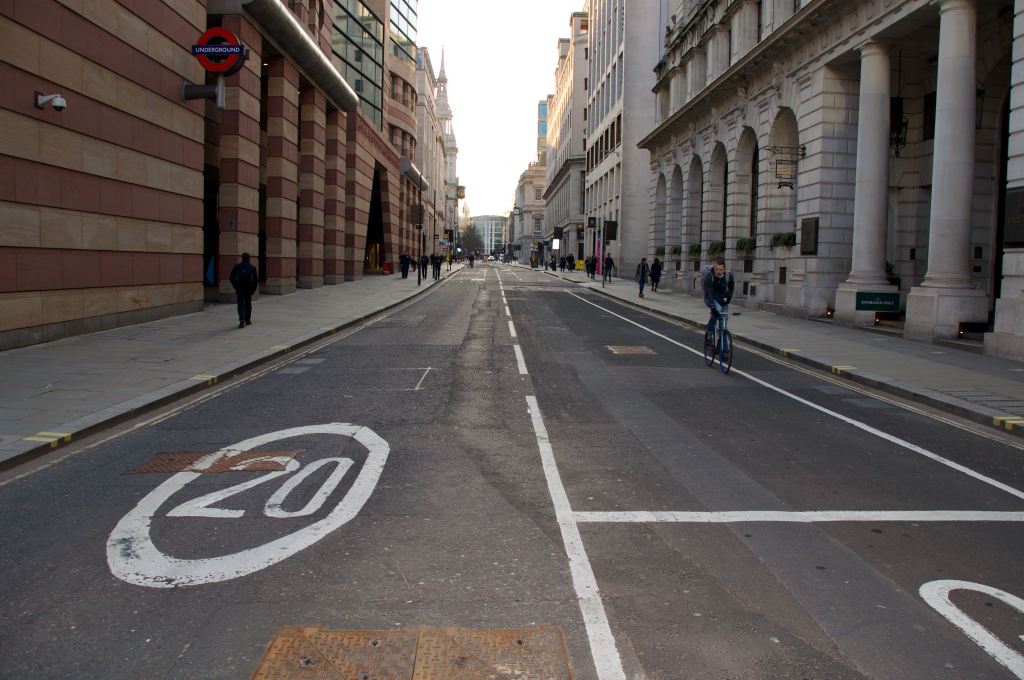
The Square Mile during rush hour – empty streets that are usually buzzing with city workers at this time of the day

Few commuters outside Bank station – this place is usually packed with commuters and traffic

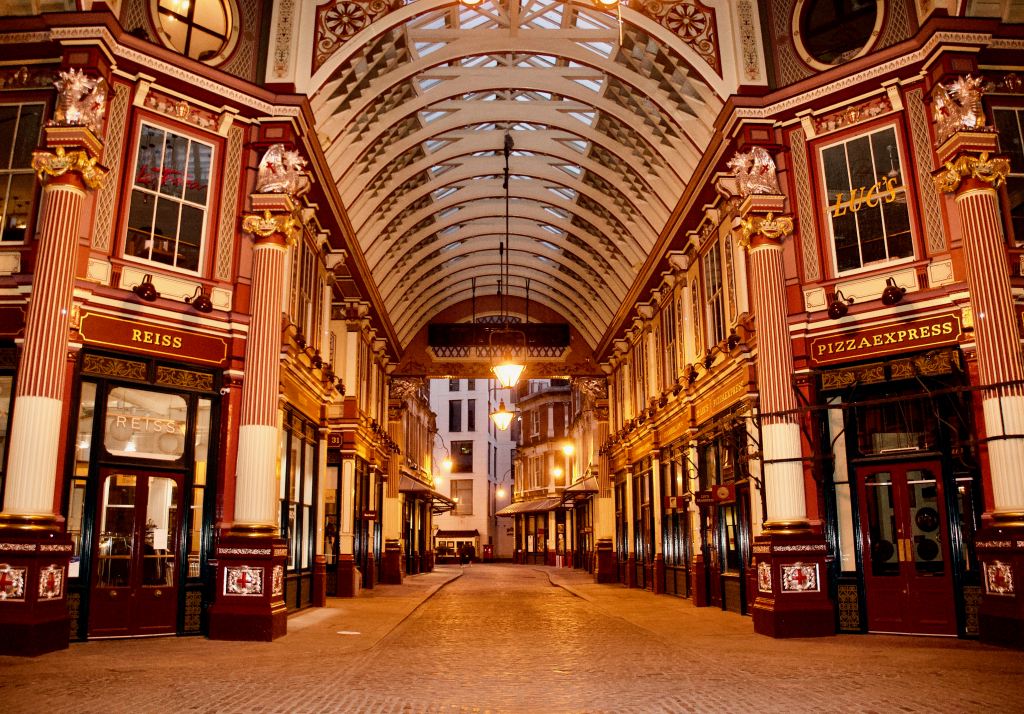
The empty court and closed doors of Leadenhall Market

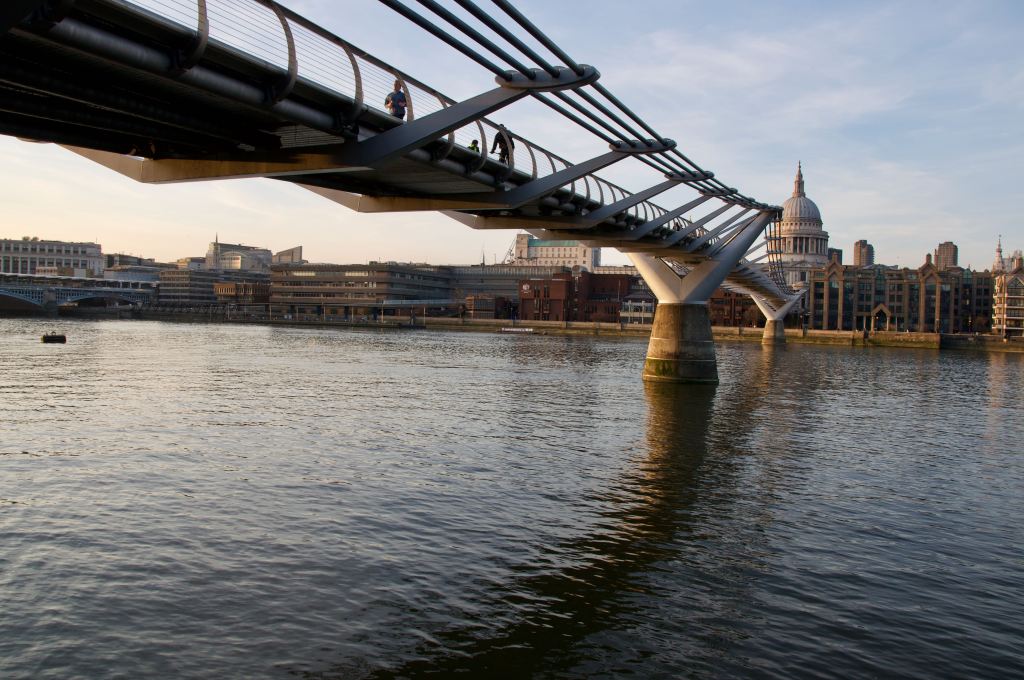
Millennium Bridge – almost empty except for few runners, cyclists and pedestrians

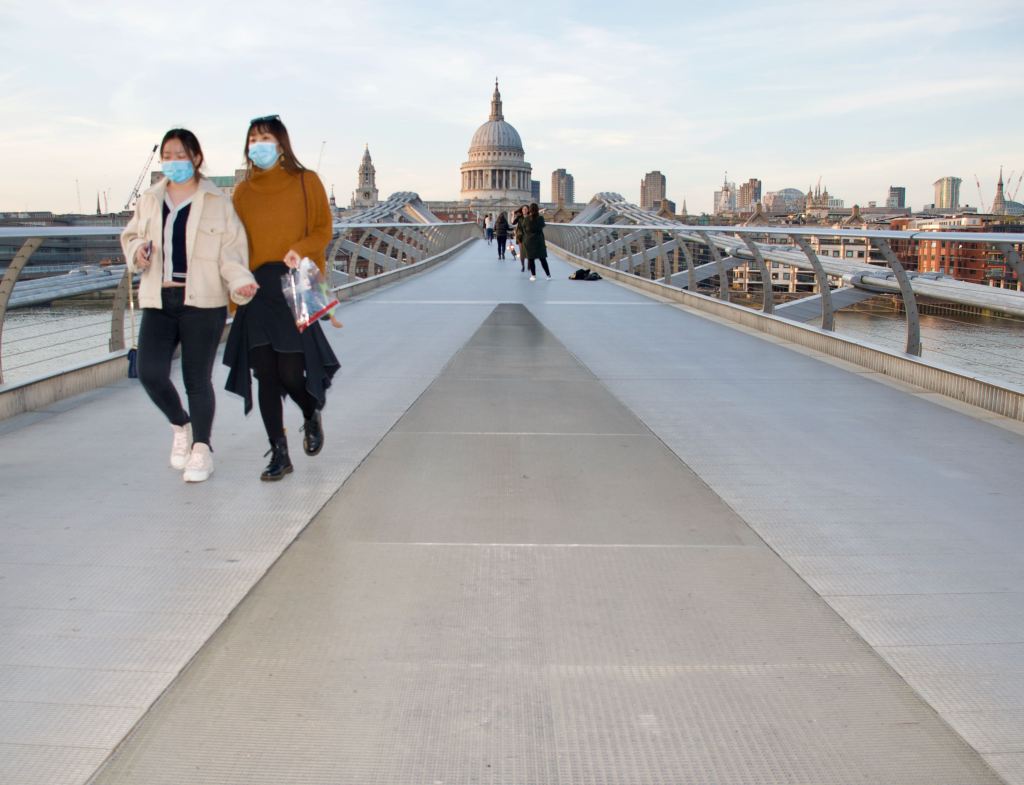
People wearing masks on Millennium Bridge

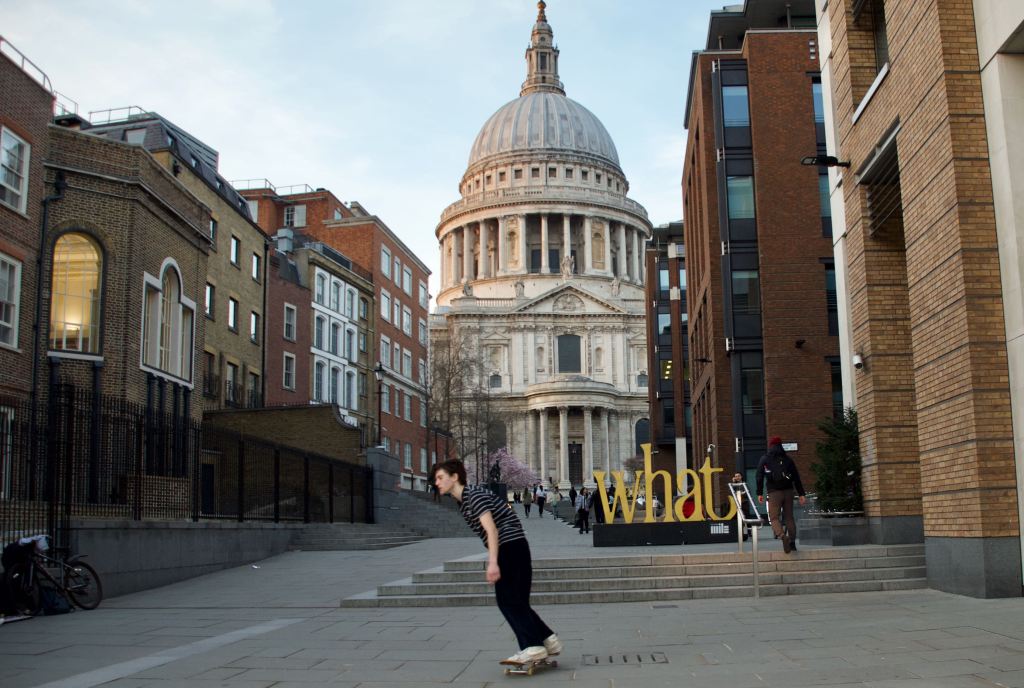
A skateboarder by St Pauls Cathedral – the streets of the City have been taken over by Skateboarders who are enjoying the deserted streets

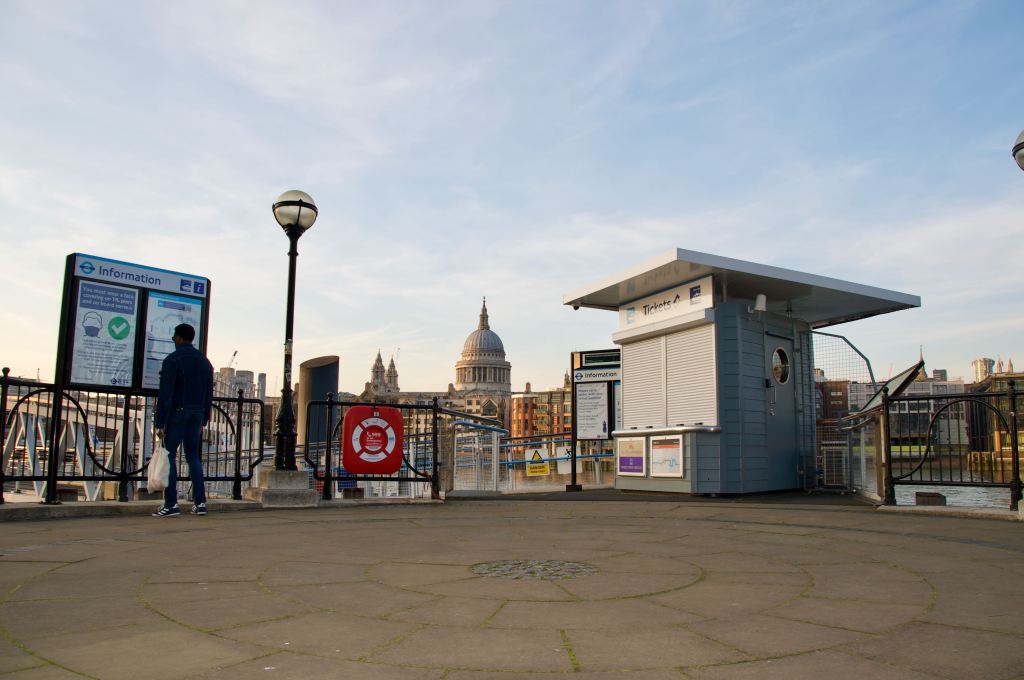
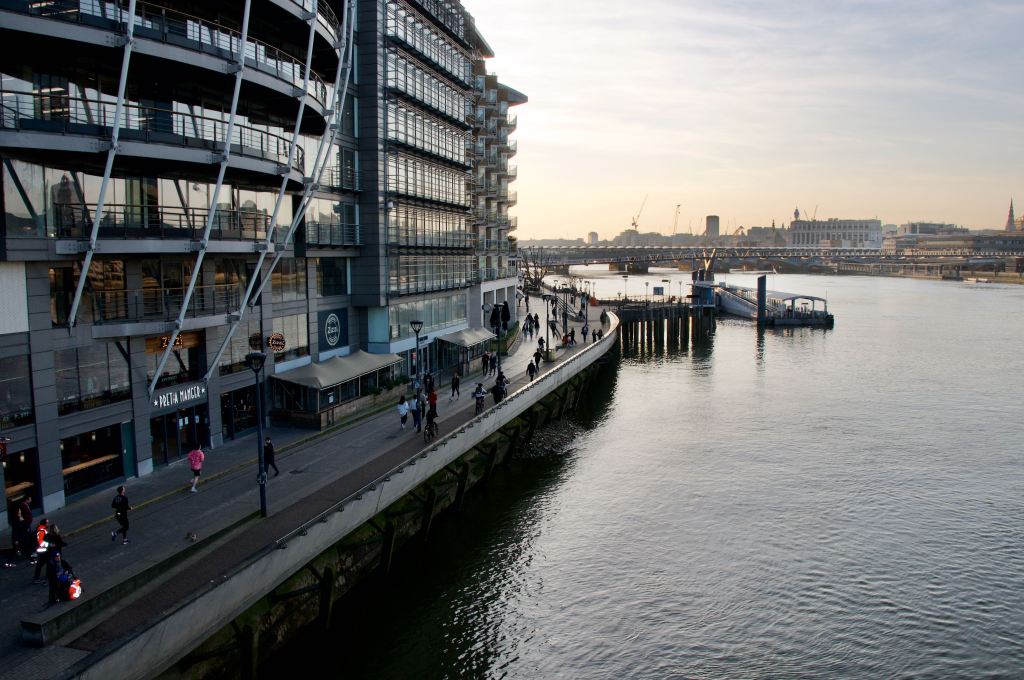
A ferry station in South Bank with its closed ticket office

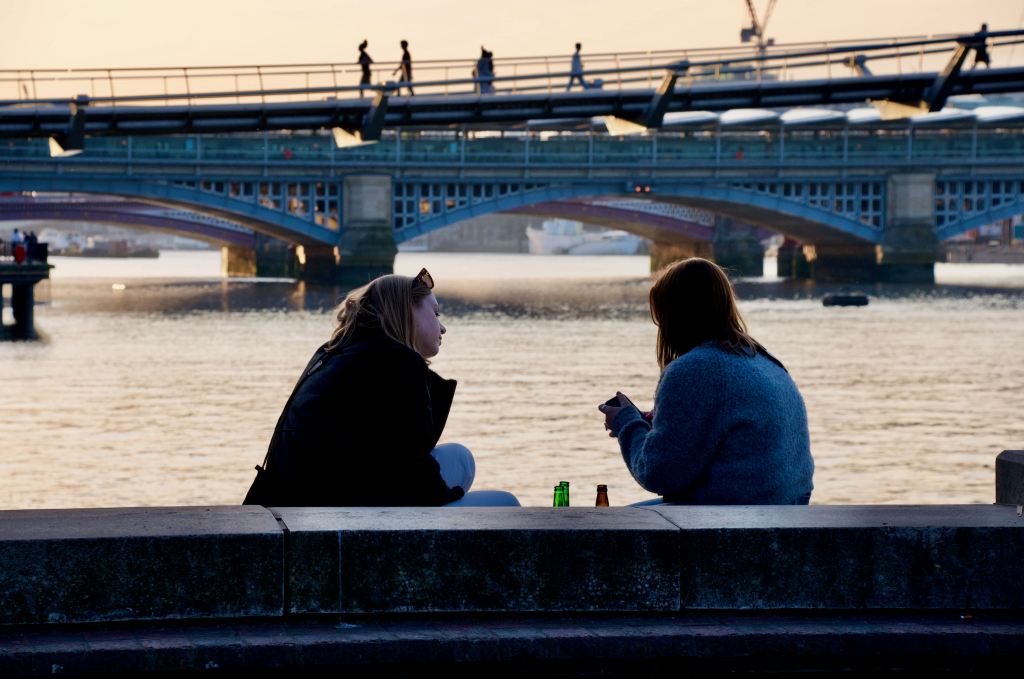
Friends enjoying a drink on the riverside – with everything else closed, riversides and parks became people’s gathering spots

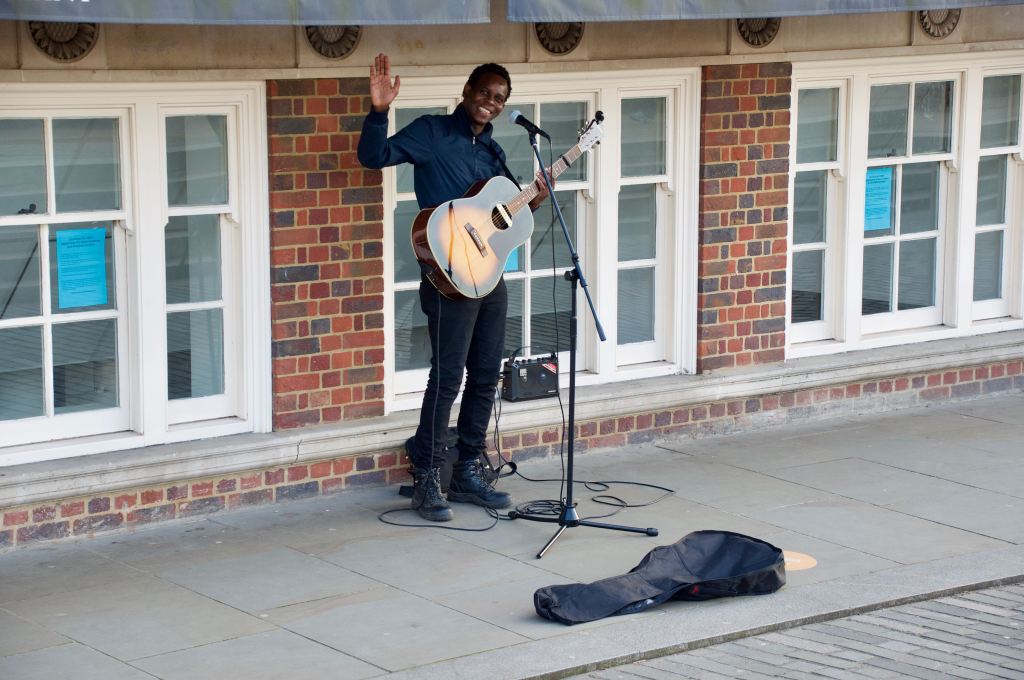
A cheerful street busker waving at me – his smile and music filled the almost deserted South Bank with vibes of positivity and hope

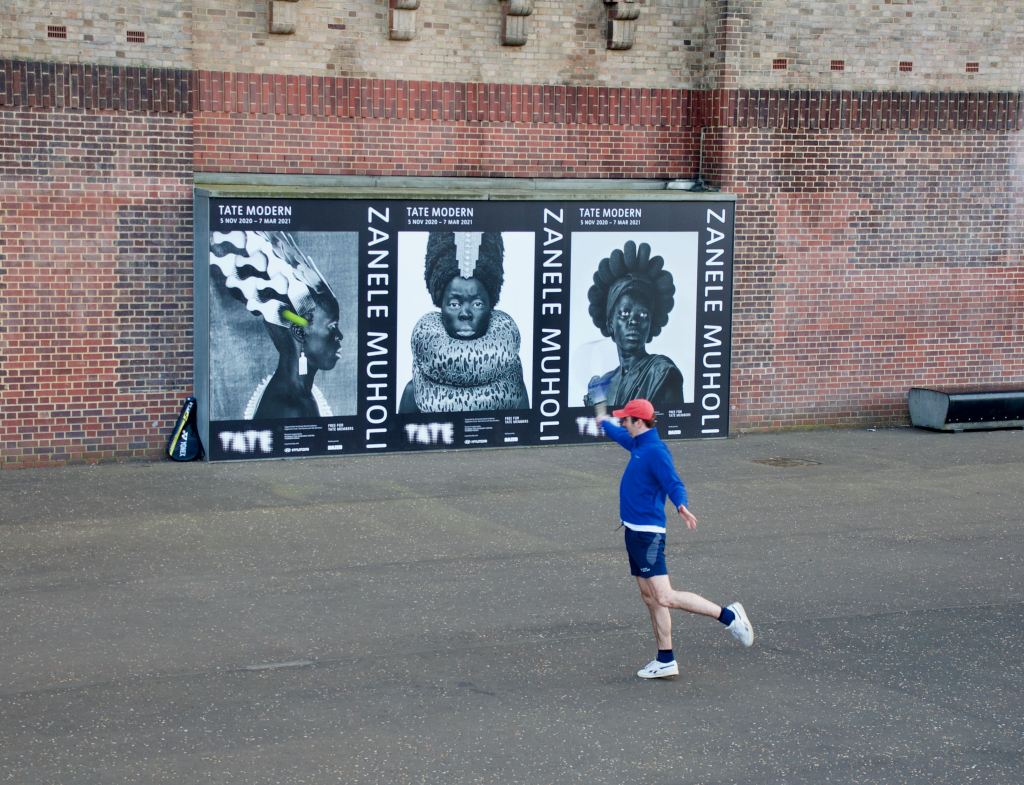
Playing tennis against the Tate Modern wall, when tennis courts were closed – what a determination!

South Bank without the tourists. Usually, this area is filled with tourists and Londoners enjoying a drink or dinner after work

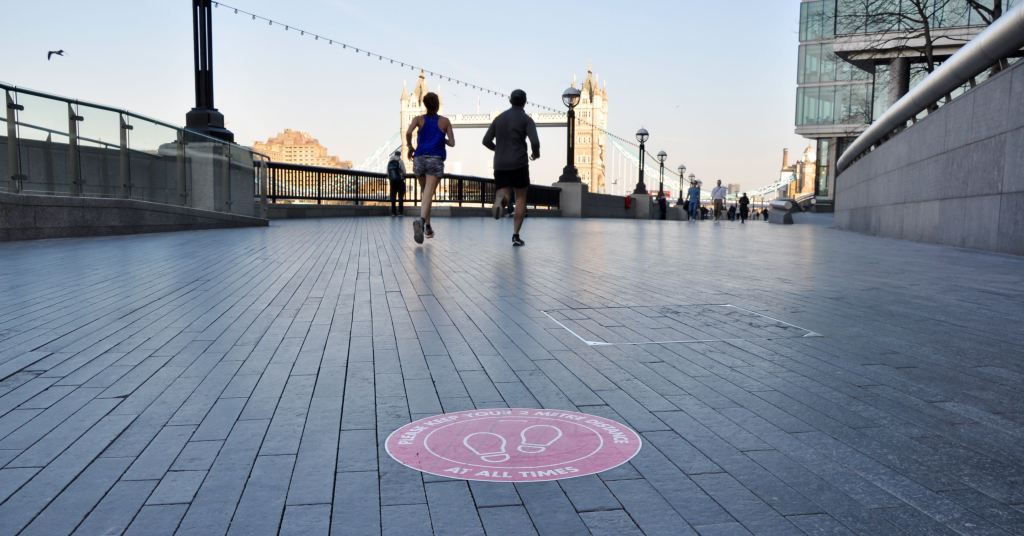
Runners on the Queens Walk heading towards Tower Bridge

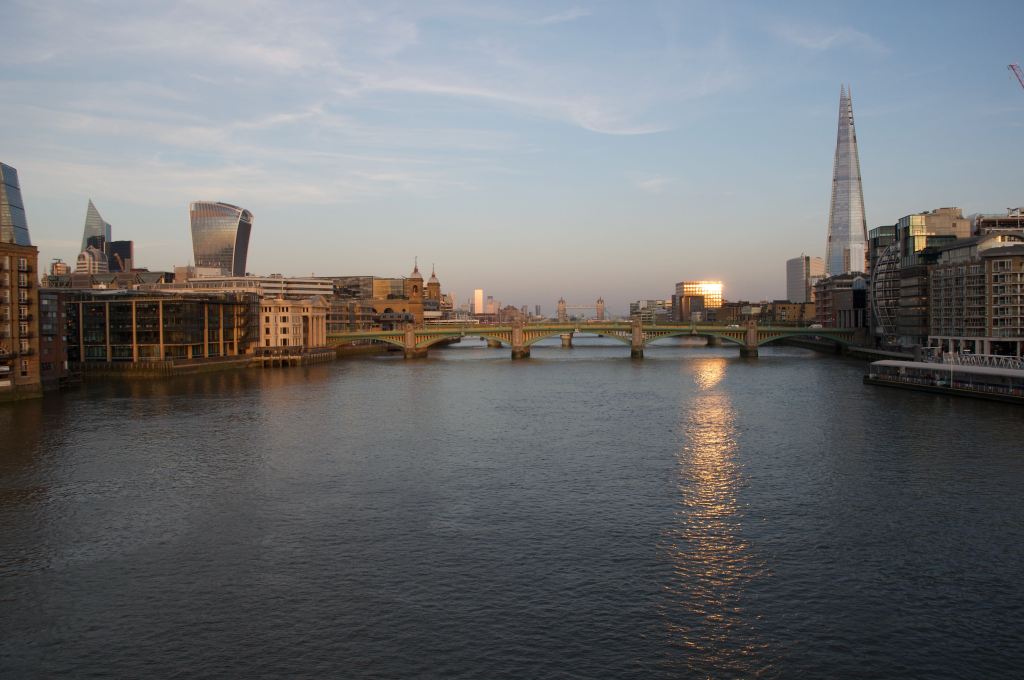
Sunset over the City. Another lifeless day had passed – how many more days or months before life comes back to the Square Mile

All pictures taken by the author on 22 March 2021.

A day in the City of Nablus

Deep into his thoughts, I watch Abu Massoud making a new tray of Knafeh – a savoury sweet confection of melted cheese and crispy pastry soaked in syrup. He layers the cheese slowly on the shredded wheat whilst listening to the Quran in the background. He doesn’t even notice the few tourists stopping by to take pictures. All his energy is on the making of this Nabulsian treat.

I ask Abu Massoud, in Arabic, if I can take a picture of him facing me. He looks at me with a smile and says “where are you from?”. “I’m Algerian,” I respond. He then rushes towards me with a big smile welcoming me to Nablus – a city that is famous not only for its Knafeh, but also for its olive oil and soap factories.

Abu Massoud preparing a new tray of Knafeh whilst another is being cooked.

Nablus is a historical city that lies in a valley between Mount Gerizim and, it’s counterpart, Mount Ebal. The Old City of Nablus existed, since before the Roman Era, around a spring under what is now known as the Balata Refugee Camp.

The view of Nablus from Sama Nablus on Mount Ebal.

The city had witnessed many conquests, and was ruled by different civilisations such as the Romans, Byzantines, Arabs and the Ottomans. When the Romans arrived, they completely destroyed the ancient city and built Flavia Neapolis (“New city” in Latin). In 636 AD, when Nablus was conquered by Arab troops, it was remodelled like Damascus, to the point that, in the 10th century, the geographer Al-Muqaddassi nicknamed it “The little Damascus”.

The Old City of Nablus

Nablus is also known for being a hotbed for Palestinian activism and nationalism. In the late 19th century, when confronted with the Turkish national movement, Zionist immigration and British colonialism, it became a political arena for the Arab national movement. It was later nicknamed Jabal en-Nar (the Mountain of Fire).

Nowadays, despite being one of the largest cities in the West Bank, Nablus is not a common tourist destination, even with everything it has to offer. At first, I wasn’t sure how safe it would be for me to travel there alone, but I got reassured by friends and the hotel personal that it’s safe. So, I take my chances, as I really want to see this culturally and industrially rich city, where religion and history meet nationalism.

I travel to Nablus, from Ramallah, using the shared taxi service. The taxi ride alone is worth the trip. Driving through the hills north of Ramallah, I get to see Palestinian villages and towns on the hillsides, and the Israeli checkpoints and illegal settlements on the hilltops.

As we arrive to Nablus’s city centre, I head straight to the Old City (Qasabah), which is a short walk away. Its architecture is dominated by Ottoman-style buildings, though one can also see elements from the Mamluk, Byzantine and Roman periods. It resembles the Old City of Jerusalem except that it’s quieter and less touristy.

The Old City of Nablus

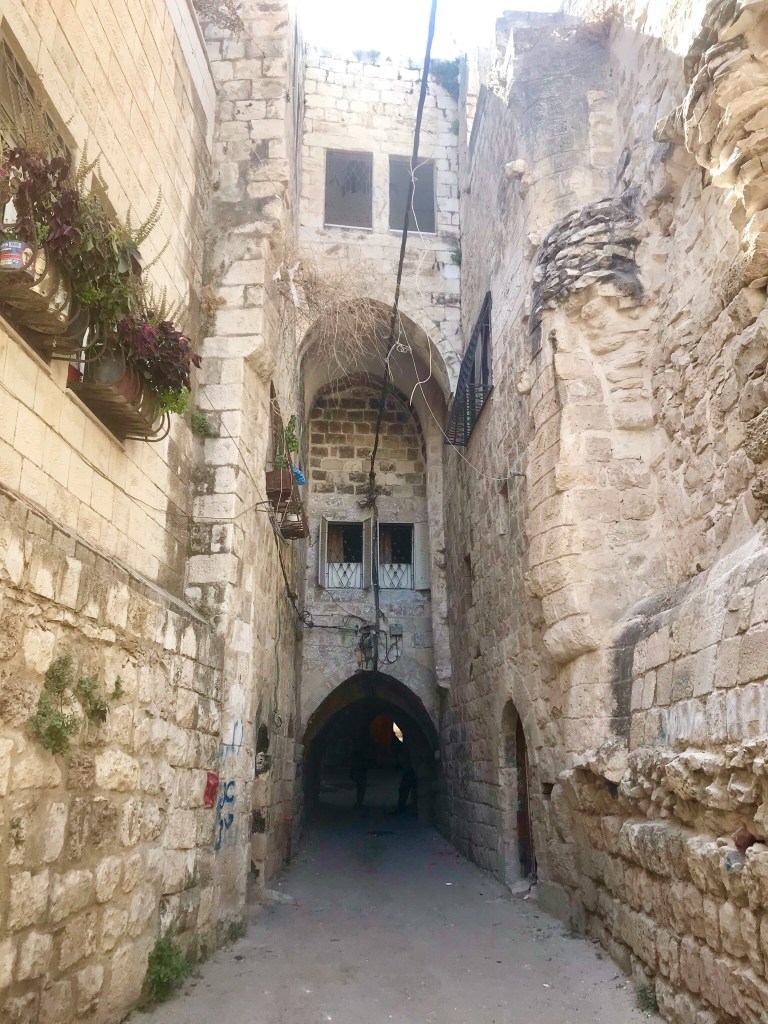
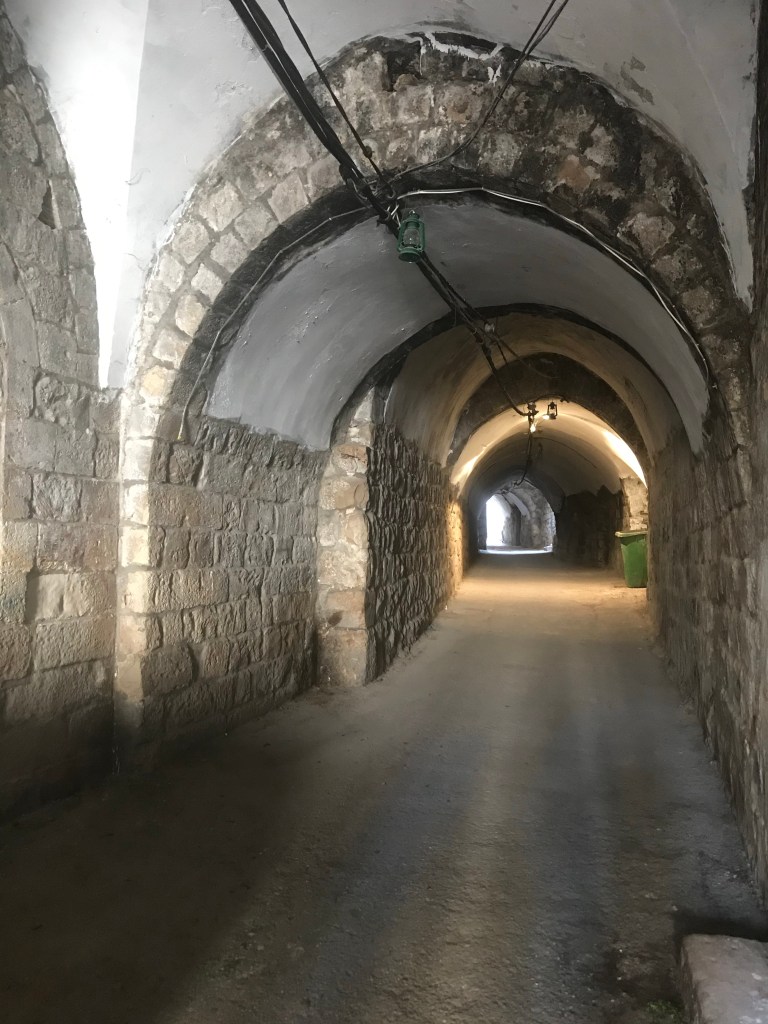
Winding through its small alleyways and arcades, I find myself moving from streets with intense business activity of numerous shops and old factories, to very quiet alleys with remains of old palaces and Hammams hidden behind unassuming doorways.

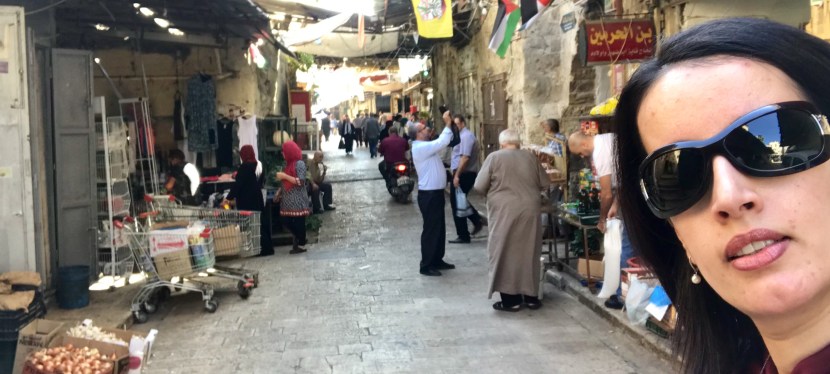
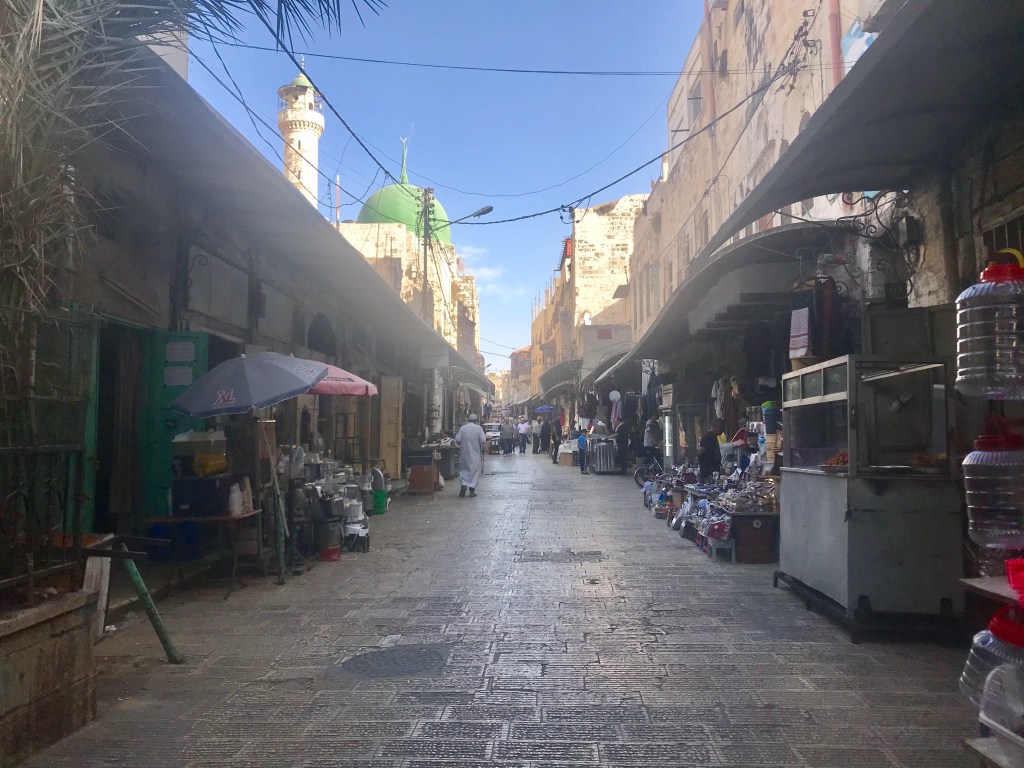
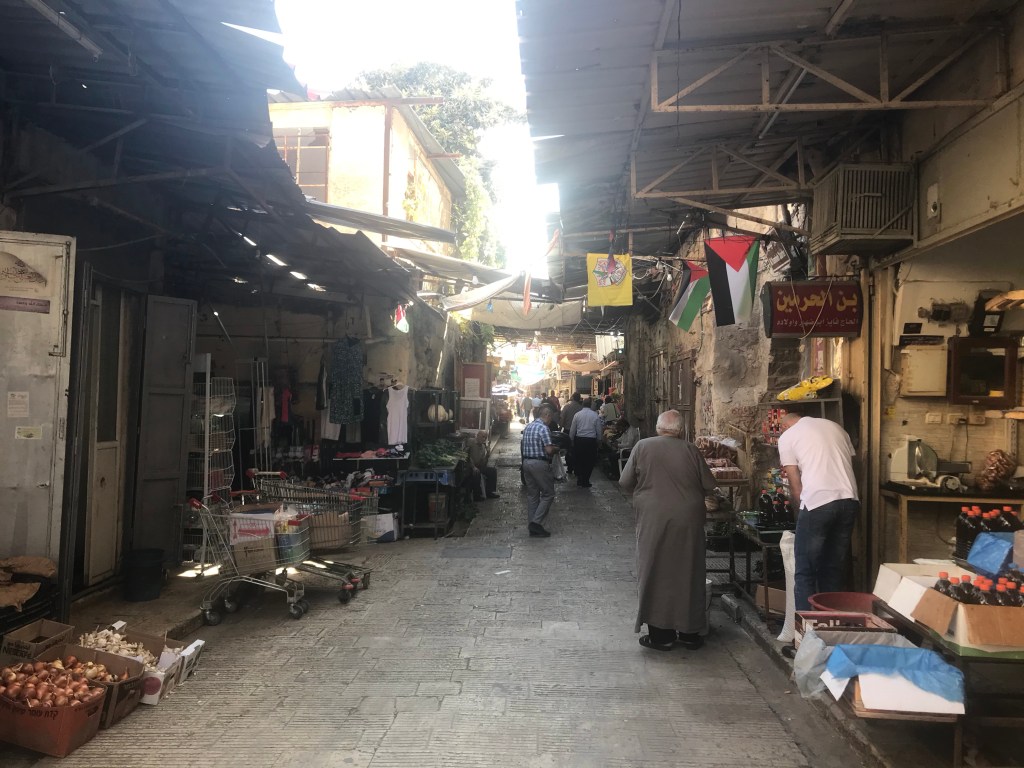
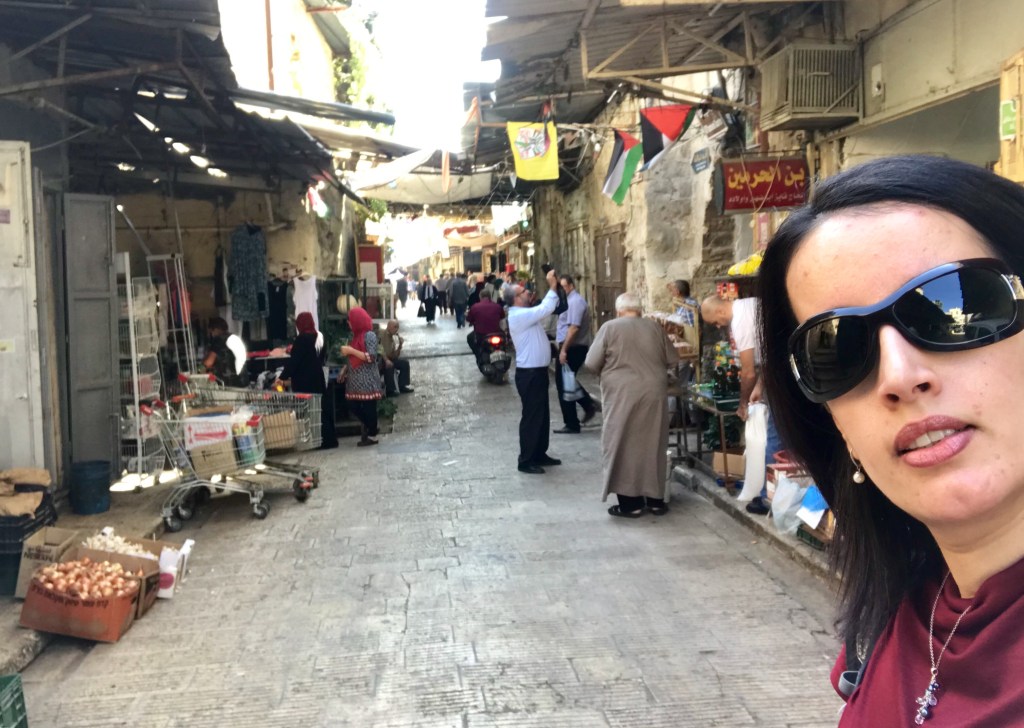
A busy street in the Old City of Nablus

The busy streets are filled with colourful stalls and smells of freshly brewed coffee, baked confections and spices; and the quiet alleys are decorated with Palestinian flags and national slogans. What strikes me about this Old City is that, despite the lack of tourists, no one tries to lure you into their shop – a common practice in Jerusalem and Hebron.

A quiet alley in the Old City of Nablus

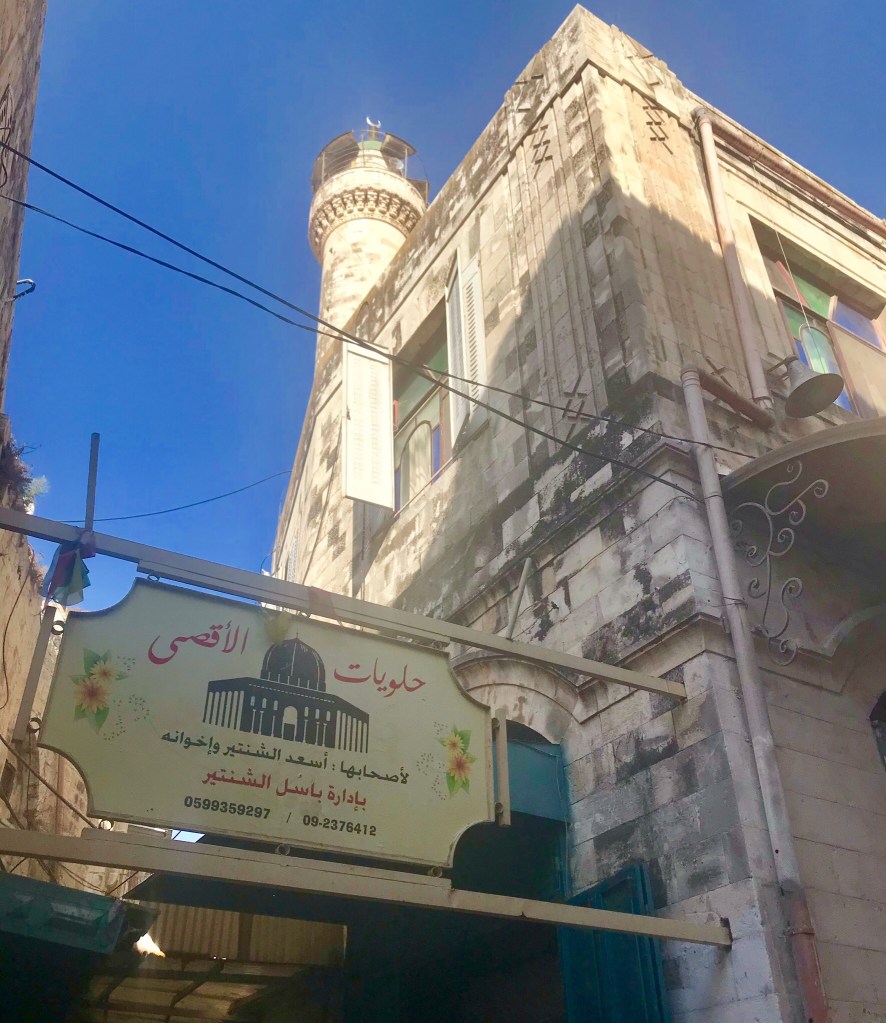
My first stop is Halaweat al-Aqsa, which is renowned for making the best Knafeh in Palestine and possibly the world. After watching Abu Massoud making a new tray with much love and dedication, it’s no coincidence if you ask anyone in Nablus where to get the famous Nabulsi Knafeh, they will point you here. This sweet treat is best eaten straight from the oven, with a freshly brewed cup of coffee. So, I indulge myself to one, before visiting the shop next door to see how the Knafeh pastry is made from scratch.

Halaweat al-Aqsa Shop in the Old City of Nablus

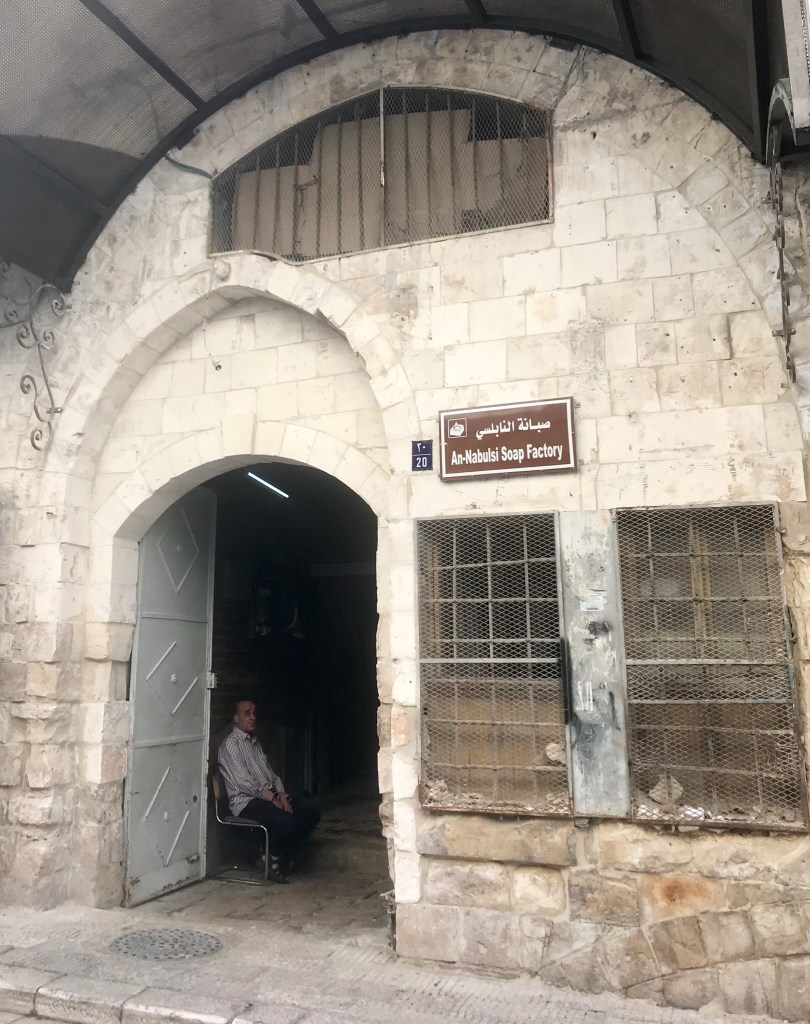
Opposite Halaweat al-Aqsa is the An-Nabulsi soap factory; one of the few factories that remain open and continue to use traditional methods for olive oil soap production – the flagship industry of Nablus. According to an article by Aljazeera, the origins of this industry stretches more than 1000 years back, but the practice evolved to an industrial scale in the 14th century.

An-Nabulsi soap factory

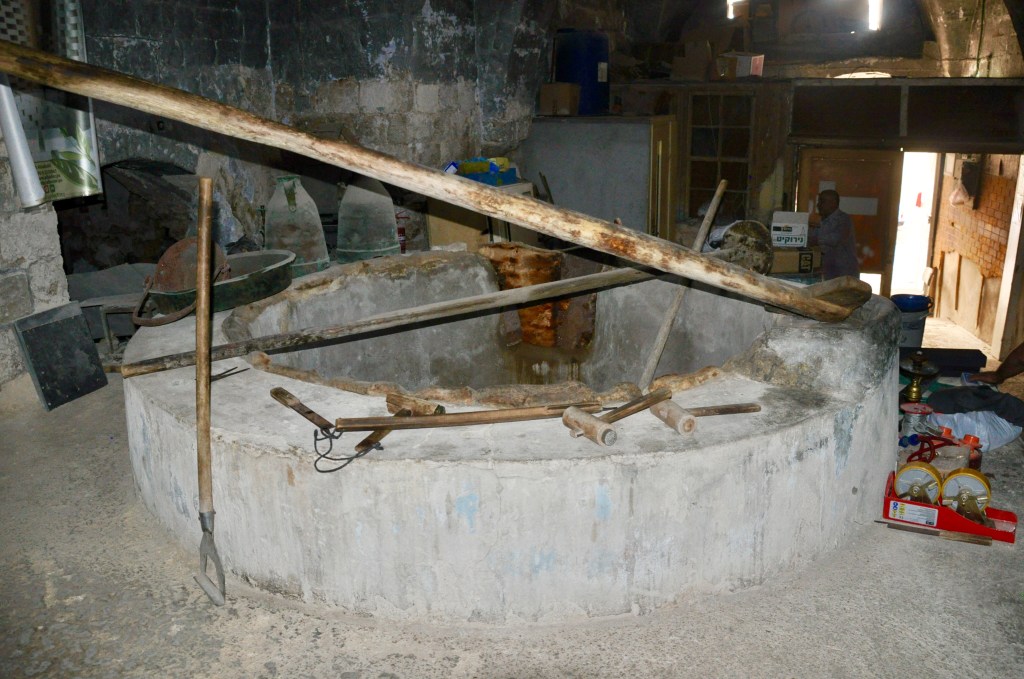
The factory is dark inside and has cemented floors and walls, and a variety of ancient tools. The owner kindly shows me around and explains the traditional process of soap production. Just before leaving, I buy some soap – a nice souvenir to take home and a way to thank the owner for the free tour.

A pit inside An-Nabulsi soap factory where the soap is mixed.

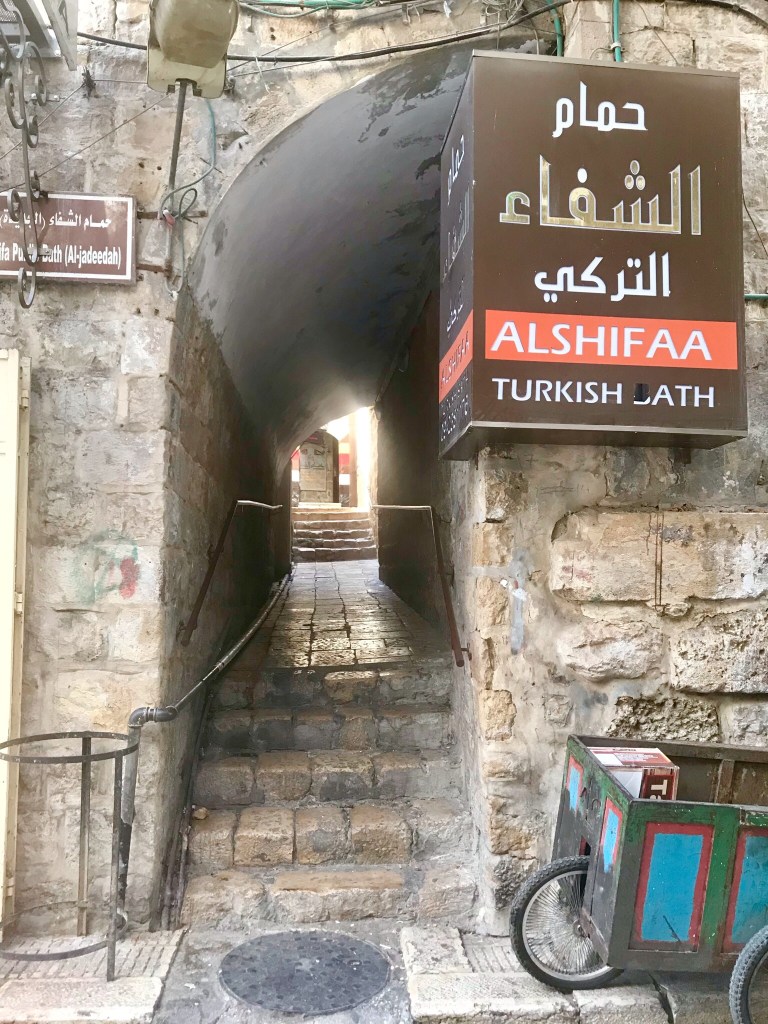
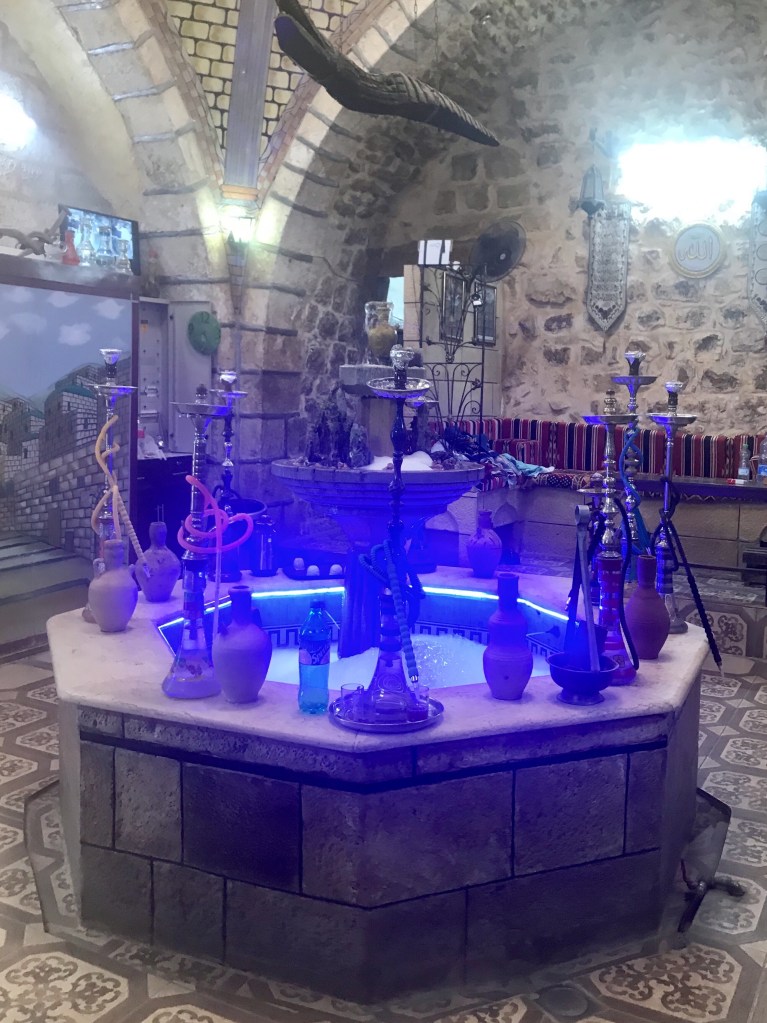
In addition to its soap production, the Old City of Nablus is famous for its Hammams an ancient tradition that has existed since the Roman times. At the beginning of the 19th century, it served an important part of Nablus’s social life. Nowadays, most of these baths are closed or have been converted into factories, but the two that remain open, Hammam esh-Shifa and Hammam al-Hana/ es-Summara, have been renovated in the 1990s to carry on the same tradition of offering locals and visitors a unique experience of well-being.

The alley leading to Hammam esh-Shifa.

I stop at Hammam al-Hana, where I’m welcomed with a cup of tea. I sit in the waiting area, slowly sipping the tea and admiring the ancient stone brick walls and the beautifully painted ceiling with its stunning architecture.

Hammam al-Hana/ es-Summara in the Old City of Nablus

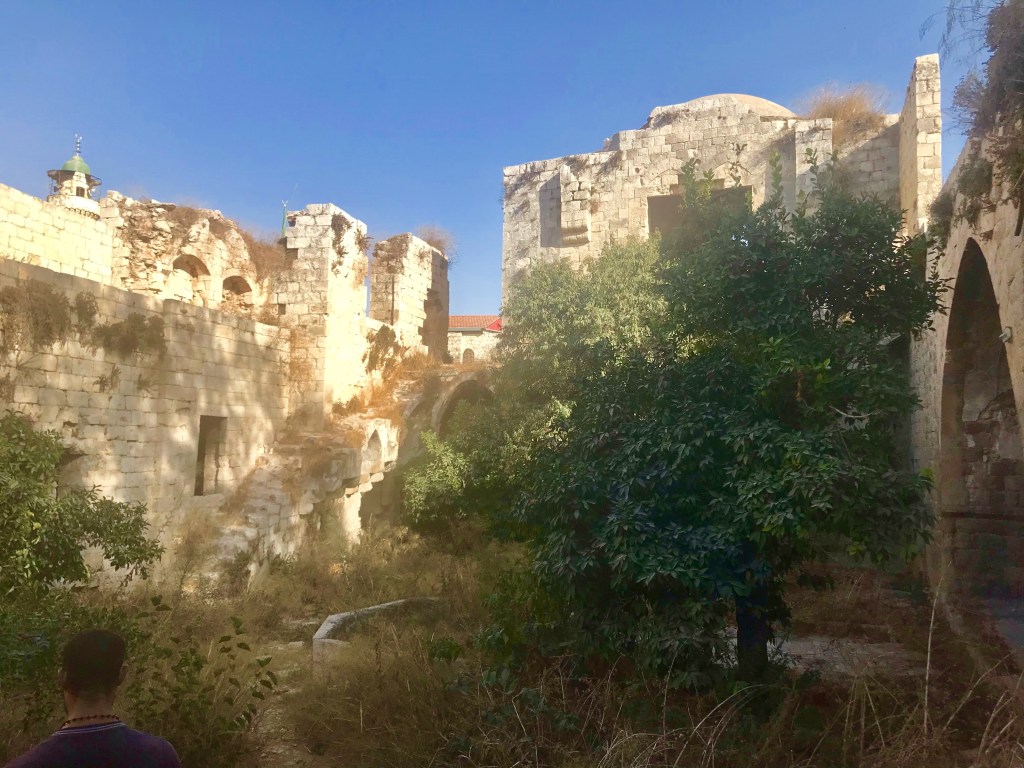
As I leave the Hammam and continue to stroll along one of the quiet alleys, I find myself next to a widely-open green door with a young man sitting on its steps. “This is the Touqan palace. It belonged to my family for generations,” the guy tells me, “do you want to visit the inside?”. So, I follow him, where he shows me ruins of what was once the palace of a well-known family in Nablus. It was built in the 18th century by a Nabulsi scholar Ibrahim beik Touqan. Sadly, today, it’s not well maintained and could benefit from a renovation project.

Ruins of the Touqan palace in the Old City of Nablus

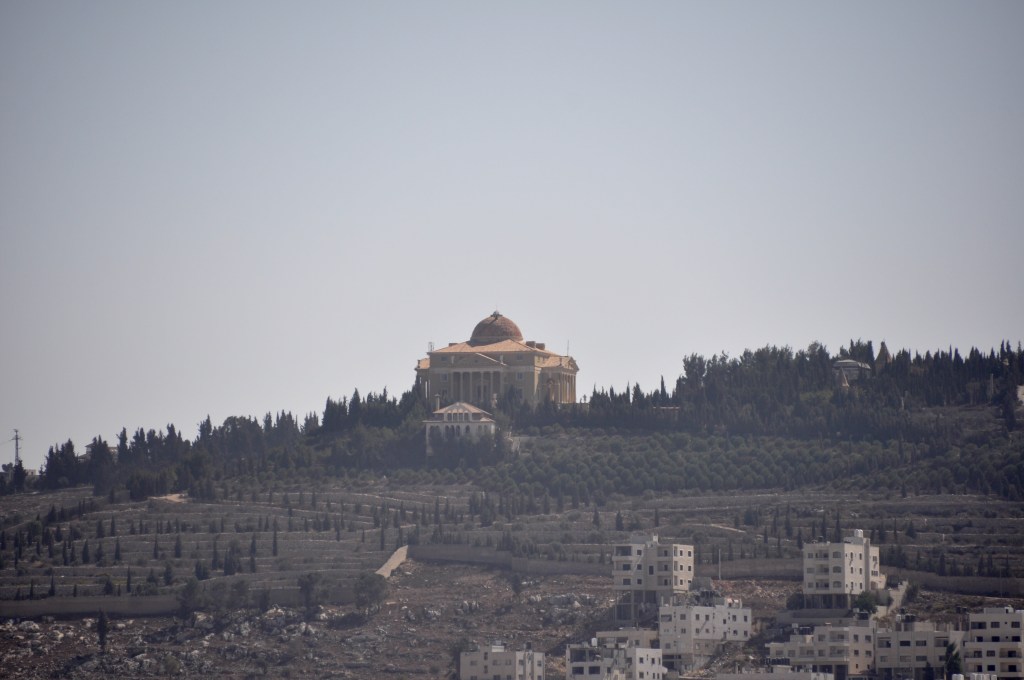
From the Old City, I take a taxi to Sama Nablus – a park on top of Mount Ebal. The view from here is breathtaking – a clear picture of the densely packed city with white washed houses and rising minarets covering the valley. In the distance, I spot a beautiful palace, with a stunning architecture, standing on the brow of Mount Gerizim. “It’s Beit Falasteen (House of Palestine),” the taxi driver tells me, “it’s the home of Munib al-Masri – the richest man in the West Bank, an oil tycoon and philanthropist.”

The view of Beit Falasteen (House of Palestine) from Mount Ebal.

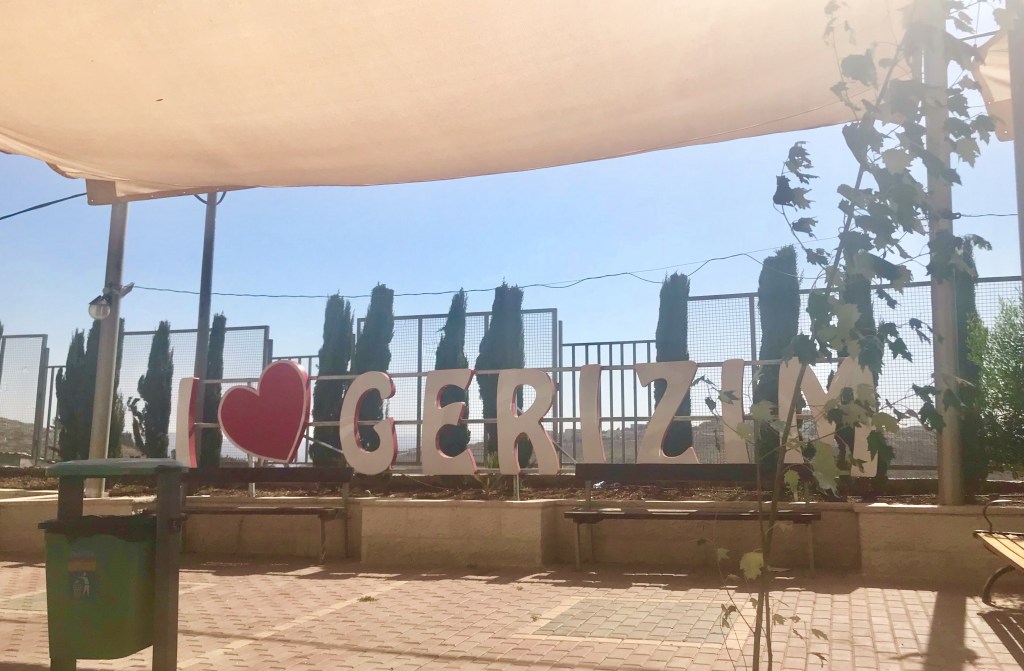
From here, I head to the hallowed Mount Gerizim – a sacred mountain to the Samaritan community; one of the oldest and smallest religious communities in the world. The mountain is home to the most ancient religious tradition in Palestine, and the Middle East in general, which goes back to the time of the Kingdom of Samaria. Samaritans believe that Mount Gerizim is the first piece of land created by God and that Adam was created from the earth of this mountain. They also believe that, on this mountain, prophet Abraham sacrificed a sheep instead of his son Isaac. Hence, they make pilgrimage here every year, on the seventh day of Passover, to commemorate the sacrifice.

On top of Mount Gerizim.

“Samaritans have similar secular traditions as Palestinian Arabs,” the taxi driver tells me. “They speak Arabic and we Arab Palestinians get on with them very well,” he continues. I later discover that although the Israelis have granted them special status, Samaritans remain attached to their Palestinian identity and institutions. In fact, those who are living in Nablus enjoy full national and civil rights as their fellow Palestinians, and they even have the right to be part of the Palestinian Legislative Council.

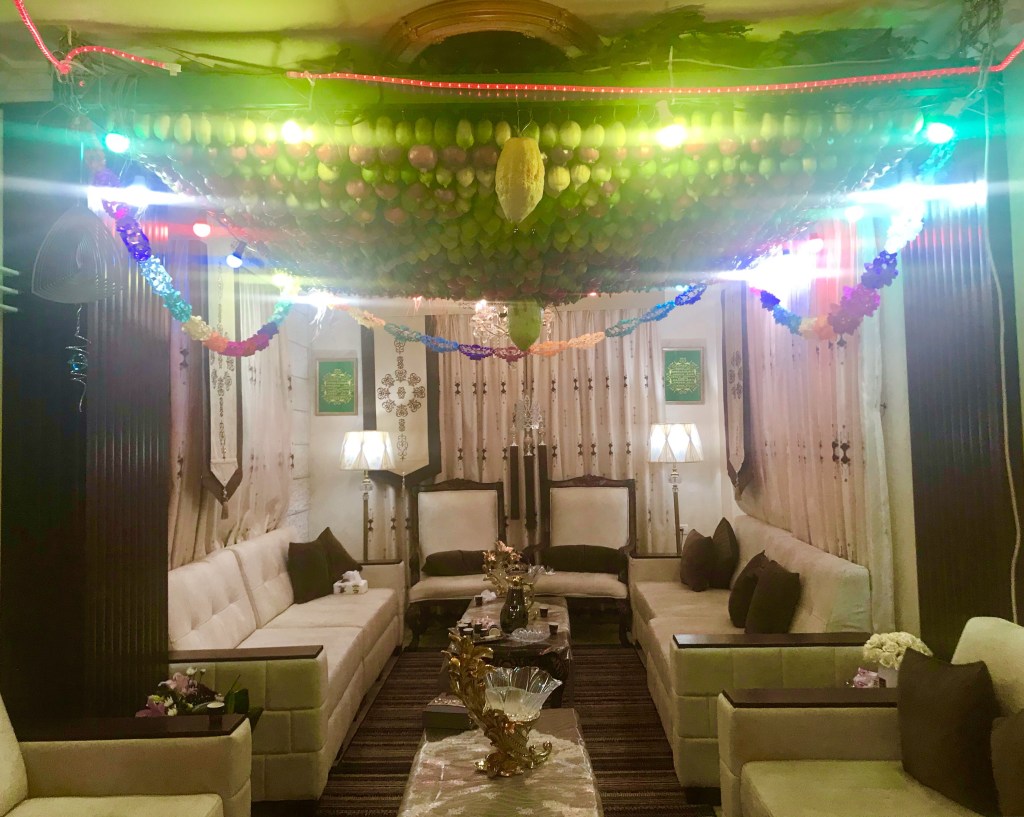
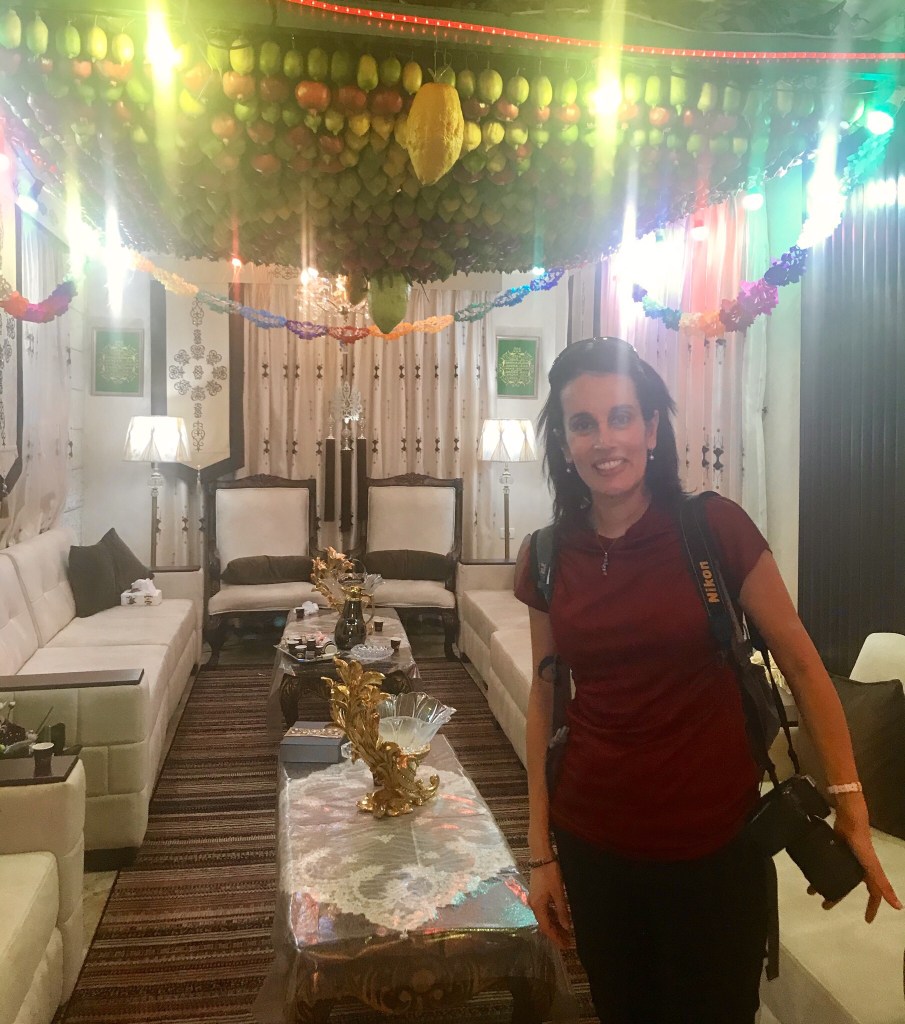
Today everything is closed on the mountain, as it’s the holy festival of Sukkot. The taxi driver; however, is able to get me inside the Samaritan museum, which is a great place to learn more about the history and culture of this community. The ceiling of one of the rooms is decorated, in the form of a tent, with fruits – mostly citrus, and vegetables. “This is a common tradition for this holiday,” the taxi driver tells me, “every household has the same decoration in a room or a tent in their garden for Sukkot”.

A Samaritan ceiling decorated with fruits in preparation for the celebration of Sukkot (Feast of the Tabernacle)

The history of the Samaritan community is fascinating, and as much as I want to spend more time exploring this holy mountain, it’s time to go back to the city centre to visit Jacob’s Well.

Inside one of the rooms in the Samaritan museum.

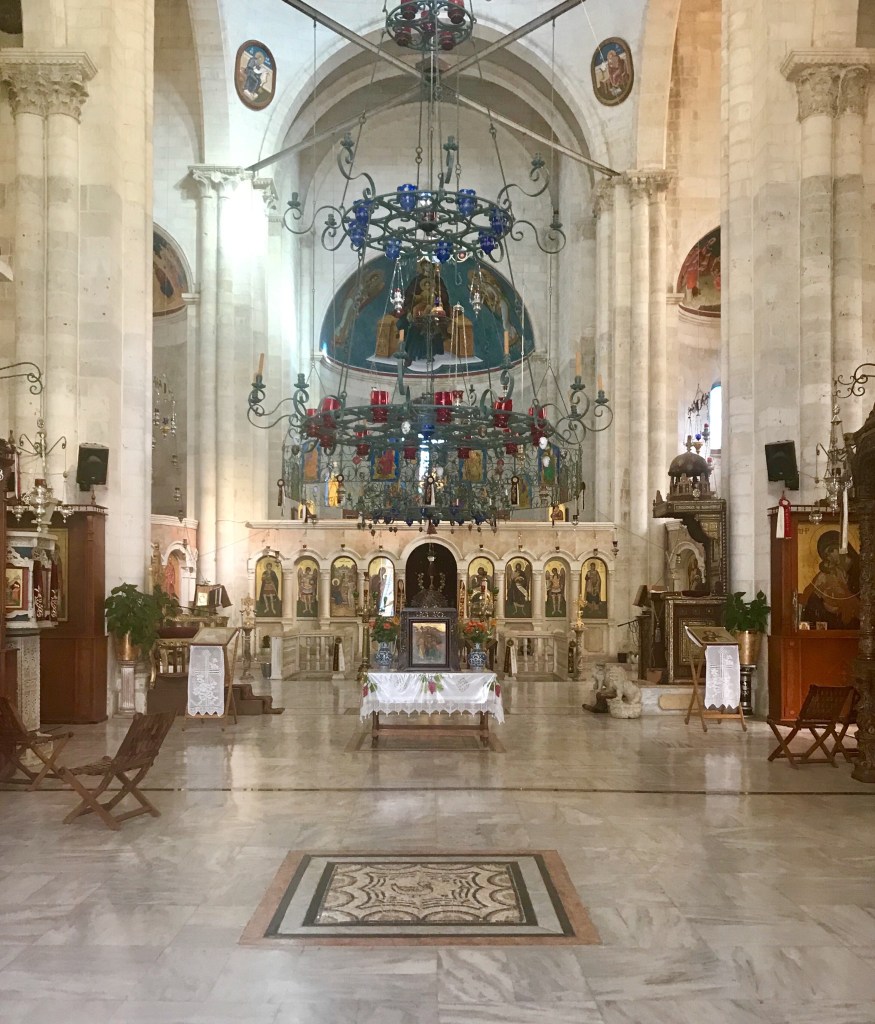
Jacob’s Well is believed to be constructed by prophet Jacob. According to Christian tradition, it’s the place where a Samaritan woman gave Jesus some water. It’s now located inside a Greek Orthodox Church and is surrounded by magnificent paintings done by the monks who work there.

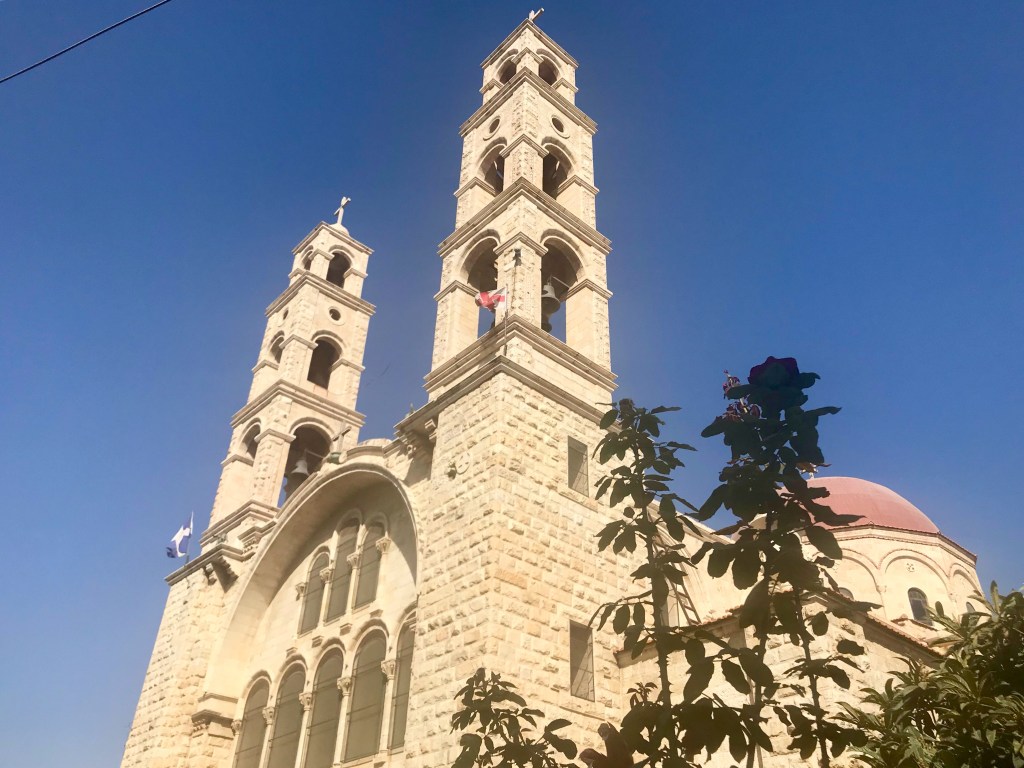
The Greek Orthodox Church built on top of Jacob’s Well.

As I pass the main entrance, I find myself in a quiet lush garden of complete serenity, away from the busy streets of Nablus. I sit on a chair and admire the architecture of the Church before going inside.

The inside of the Greek Orthodox Church where Jacob’s Well is located.

It’s now time to tear myself away from this beautiful city. A city with layers of history that get uncovered slowly as one moves from one corner to another. I leave behind a place with many religious tales; a place that is fighting hard to protect its identity. At the end, Nablus is not just the city of Knafeh and olive oil soap production, it’s also a city with great historical significance and a place where religious faiths come face to face with nationalism.

Farewell to the Old City of Nablus

Practical Information

How to get to Nablus – The best way to get to Nablus is from Ramallah, using the shared taxi service from the Central Service Station (2nd level of the parking garage) – very close to the Manara square. The journey takes 1.5 to 2 hours depending on the traffic and checkpoints. The taxis run frequently; they normally depart when all 7 passenger spaces are filled.

How to get around Nablus – Most sites of interest are within walking distance from the city centre, where the taxis stop. To get to Mounts Ebal and Gerizim, it’s best to hire a taxi .

What to wear – Nablus is a conservative city, much like the rest of the West Bank. It’s important to dress moderately and avoid wearing shorts and sleeveless tops.

The Hammams

Hammam esh-Shifa – En-Nasser street in the Old City of Nablus. Opens daily for men except Tuesdays and Sundays (8am-5pm) for women. Built in 1624 by the Touqan family. Best to contact them before travelling to confirm opening times and days as these might change.

Hammam al-Hana – Jadet al-Yasmina street in the Old City of Nablus. Opens daily for men except Tuesdays (8am-5pm) for women. Best to contact them before travelling to confirm opening times and days as these might change.

The West Bank: Ten reasons to put it on your travel bucket list

The day I told people I was going to the West Bank, I got incredulous looks and moments of silence before I heard someone saying “Wow! Interesting choice of destination! Are you sure it’s safe to go there?”.

In reality, I was also skeptical. What’s meant to be a land of spirituality, holiness and historical richness has been in the midst of the biggest political crisis and under occupation for decades.

However, once you set foot there, it’s a different story. You will find it hard not to be moved by the myriad of beautiful landscapes, the spiritual magnetism of the place and the generosity of the Palestinians.

If the West Bank hasn’t made it to your travel bucket list yet, here are ten reasons why it should whether you are looking for a spiritual journey or an adventure to satisfy your curiosity.

1. The Old City of Jerusalem: A historical journey inside its walls

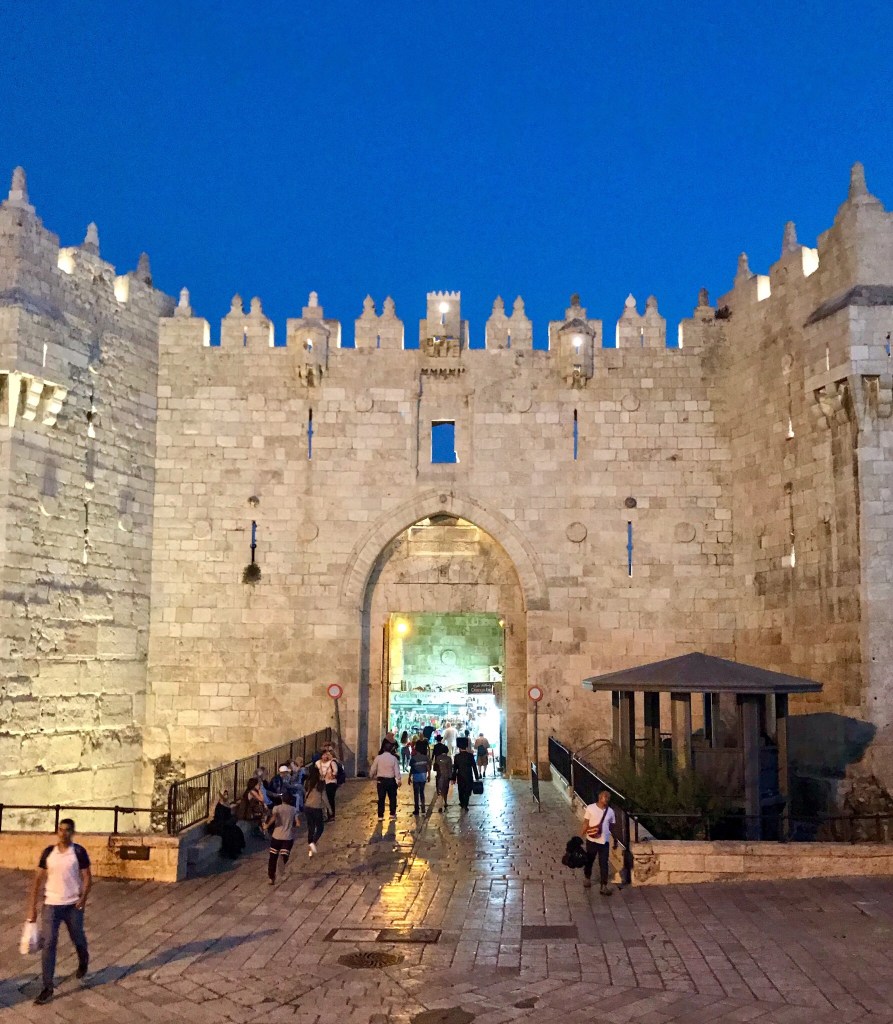
Bab el-Amoud/ Damascus Gate – One of the eight entrances to the Old City of Jerusalem.

As you step inside the 16th-century Ottoman wall surrounding the Old City of Jerusalem, you get transported back into the pages of history, where past civilisations lived and layers of ancient architecture and monuments still stand.

The Old City is a labyrinth of small alleyways filled with traditional souks and colourful merchandise. It’s divided into four quarters: Armenian, Christian, Jewish and Muslim – each with its own style.

The Muslim quarter is the most vibrant with its small eateries and street markets. Like its neighbouring Armenian and Christian quarters, it has preserved its traditional character. The Jewish quarter, on the other hand, has lost its historical style to a modern look.

2. Jerusalem: Home to some of the holiest sites in the world

Holy Sepulchre – Devoted worshipers kneeling at the stone that’s believed to be the place where Jesus was anointed after being crucified

Most people visit Jerusalem for spiritual reasons, and the ones who don’t can still sense its spiritual magnetism through its religious sites and devoted pilgrims. The Old City of Jerusalem is home to a plethora of religious sites that are of great significance to the three Abrahamic faiths.

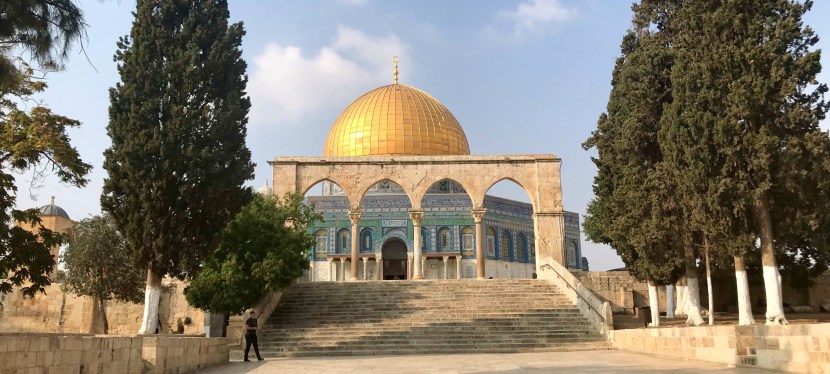
Whether you’re visiting for religious reasons or not, it’s hard not to be moved by the sight of Muslim worshipers flocking the doors of the Al-Aqsa mosque (Dome of the Rock) at prayer times; Christian pilgrims kneeling at the stone on which Jesus was anointed inside the Church of the Holy Sepulchre or Jewish supplicants wailing at the Western Wall.

3. Sunset from the Austrian Hospice

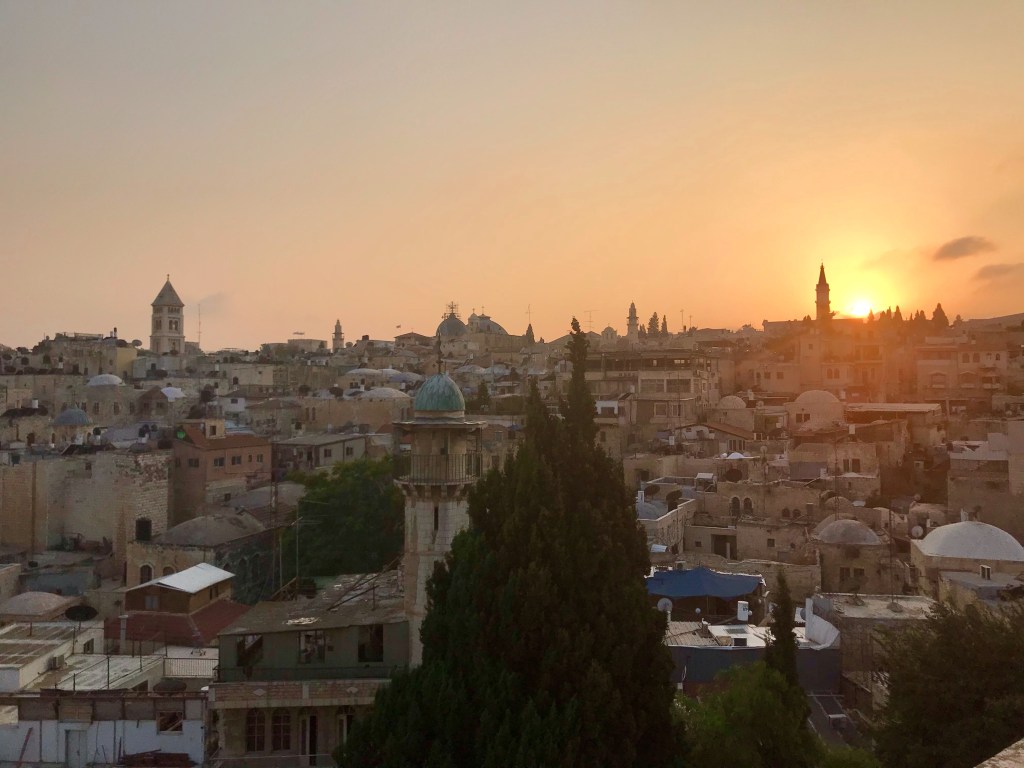
View from the Austrian Hospice rooftop

The Austrian Hospice is a Christian guesthouse, situated in the middle of the Muslim quarter in the Old City of Jerusalem. It was built in 1854 for pilgrims by the Archbishop of Vienna, who still owns the institution today.

At sunset, you can witness beautiful views, from its rooftop, of the sun settling down slowly over the limestone buildings of the Holy Land, whilst listening to the call to prayer echoing from different angles – a perfect place to unwind after a long day of sightseeing.

4. Bethlehem: A biblical jewel

The old town of Bethlehem

Bethlehem is one of the most touristic cities in the West Bank. It’s flooded with Christian pilgrims and non-religious tourists alike who come to visit the birthplace of Jesus.

The city is dominated by a unique limestone architecture, traditional souks and a relaxed atmosphere. The heart of the city, Manger Square, is filled with tourist groups and local by-passers admiring the surrounding religious sites such as Church of the Nativity, Milk Grotto and Omar Ibn al-Khattab Mosque.

The old part of the city is filled with bazaars, eateries and food markets where visitors can admire colourful artisan work and watch the daily life of Palestinians.

5. The Wall of Separation: A first-hand look at the struggle of the Palestinians

The Wall of Separation in Bethlehem

The Wall of Separation is a living reality of the Palestinian struggle, and depending on which side of the wall you stand, you will hear a different story- a wall of apartheid versus a security barrier.

To the Palestinians, it’s a wall of apartheid and occupation that affected many families economically and emotionally when they lost their lands. To the Israelis, it’s a security barrier. The reality is that it’s a giant and ugly concrete wall twisting like a serpentine separating the West Bank from the rest of the country.

Opposite the Walled Off Hotel in Bethlehem, the wall has been turned into a canvas for artists and non-artists alike to express their hope for a resolution, dismay of what is happening and feelings of oppression.

6. Ramallah: A cosmopolitan city inside a turmoiled region

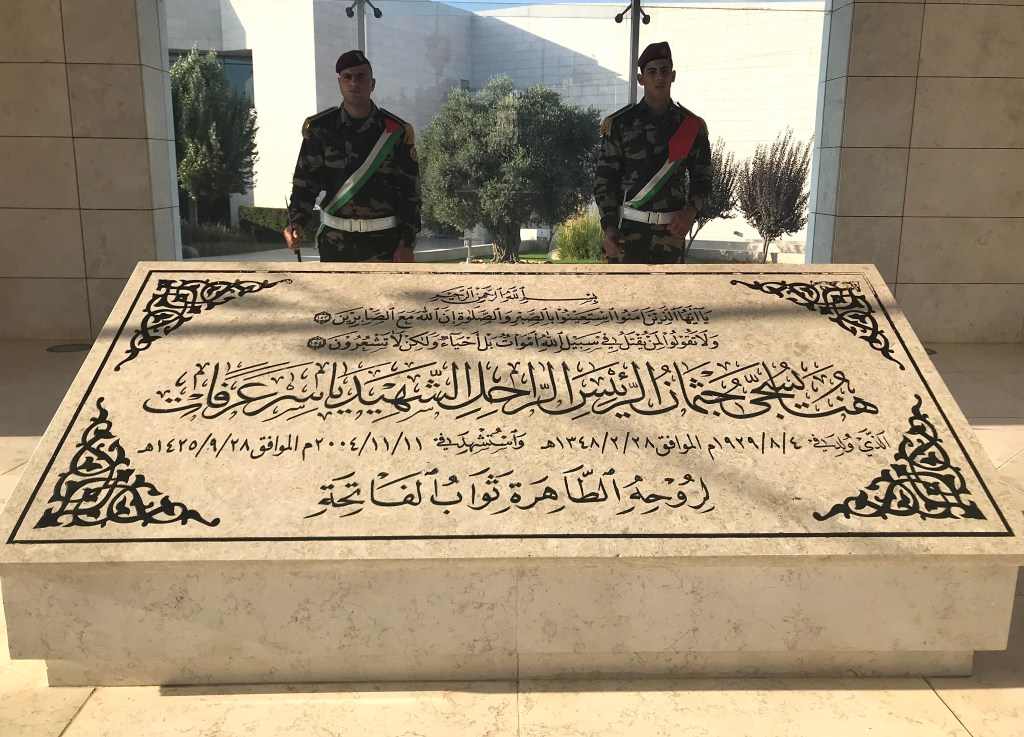
Yasser Arafat museum and mausoleum

Ramallah is the administrative capital and the most vibrant city of the West Bank. The street leading to the crowded Manara Square – with its iconic four-lion statues – is filled with nice smells of freshly baked bread and coffee waft coming from shops.

It’s home to the Yasser Arafat museum and mausoleum, which is an inspiring place to look at over 100 years of Palestinian history and to get an insight into the life of the late Palestinian president.

Mahmoud Darwish is another museum to visit, on the hilltop of Al Masyoun. It was built in tribute to the famous Palestinian poet Mahmoud Darwish.

7. Nablus: The little Damascus of Palestine

View over Nablus from Mount Ebal

The city of Kunafeh, olive oil and soap factories is nestled in a valley between Mount Gerizim and Mount Ebal. Its old city is a labyrinth of narrow Ottoman-style alleyways filled with colourful vegetable stalls, spices and coffee shops.

Visitors can also go to Mount Ebal for beautiful views over the city, and Mount Gerizim to get an insight into the culture and history of the Samaritan community – one of the oldest and smallest religious communities in the world and which consider Mount Gerizim as a sacred place.

Nablus is also home to Jacob’s Well, which is believed to be constructed by prophet Jacob. Today, it’s found inside a Greek-Orthodox Church with a quiet lush garden. According to Christian tradition, it’s the place where a Samaritan woman gave Jesus a jug of water.

8. El-Khalil (Hebron): Home to al-Haram al-Ibrahimi and a living example of Israeli settlements inside the West Bank

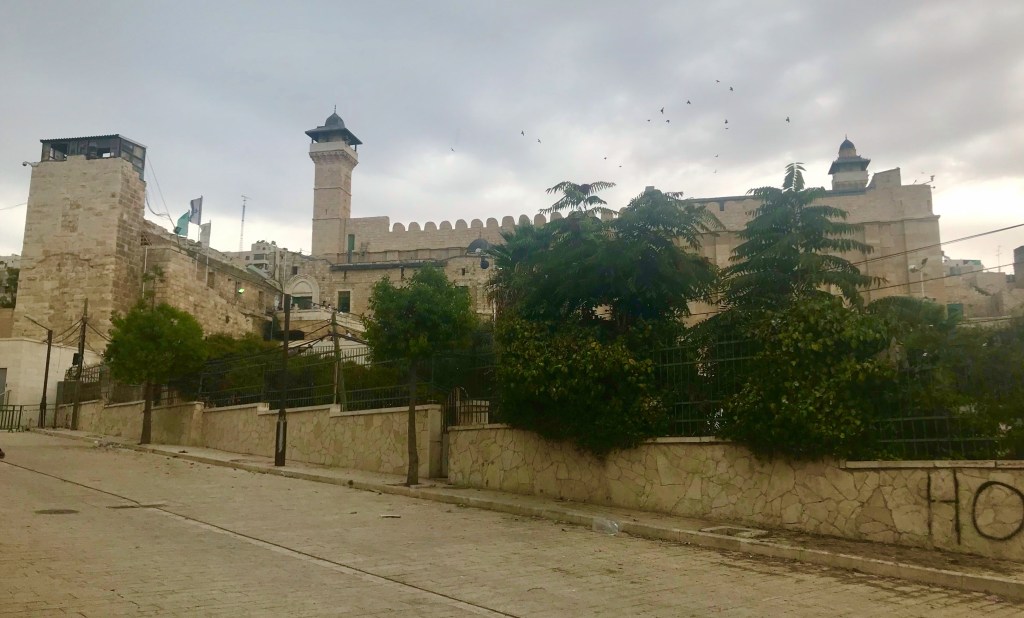
Al-Haram al-Ibrahimi in Hebron

El-Khalil (Hebron) is an interesting city to visit not only because it’s home to al-Haram al-Ibrahimi, but it’s also the place where the impact of illegal settlements can be seen in the heart of its centre.

The alleyways of its old city are covered with metal nets and plastic sheets to protect shop owners and by-passers from the garbage and stones thrown at them by the settlers, who occupy the houses above the shops.

The old city feels like a ghost town, as most shops are now closed. The ones that remain open are; however, a delight to shop from and look at beautiful embroidered materials and local artisanal products.

Al-Haram al-Ibrahimi is the key site in El-Khalil. It’s believed to be the resting place of prophet Abraham and his family, hence its great significance to all three Abrahamic religions and the reason for the tensions inside this city. It’s split into two parts with a wooden door and a bullet-proof window; one part for Muslims and the other for Jewish people.

9. Culinary richness of Palestine

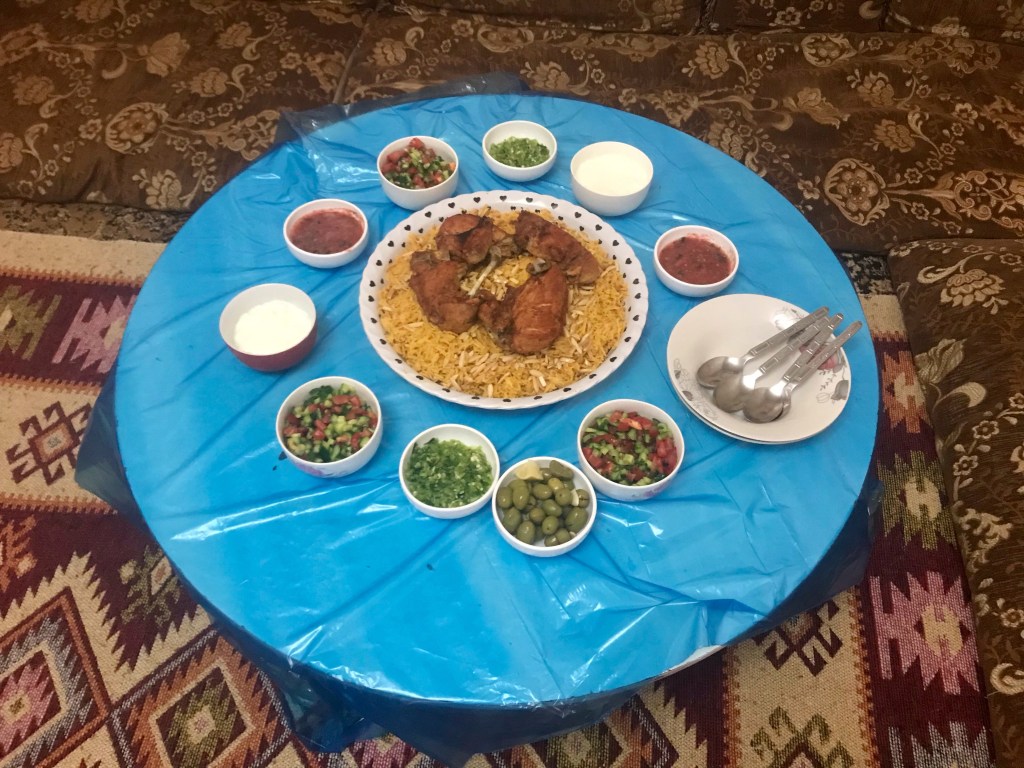
Palestinians take pride in their gastronomic landscape and consider it part of their identity and heritage. A Palestinian culinary experience is an attraction that you can indulge in small eateries or fine dining restaurants. The dishes vary in style from Mezzas, to meaty mains like Maklouba and delicious deserts like Kunafeh.

10. Hospitality of the Palestinians

The Palestinian hospitality is famous in the Arab world and it’s very real. As a visitor, you will be flooded with warmth and invites for coffee or tea, which sometimes gets extended to dinner invitations. Don’t be surprised or alarmed by these gestures – hospitality has been a trait of the Palestinians for generations. Nowadays, it’s a way for them to tell their story over a drink or a meal.

In the Casbah of Algiers – A journey into the past

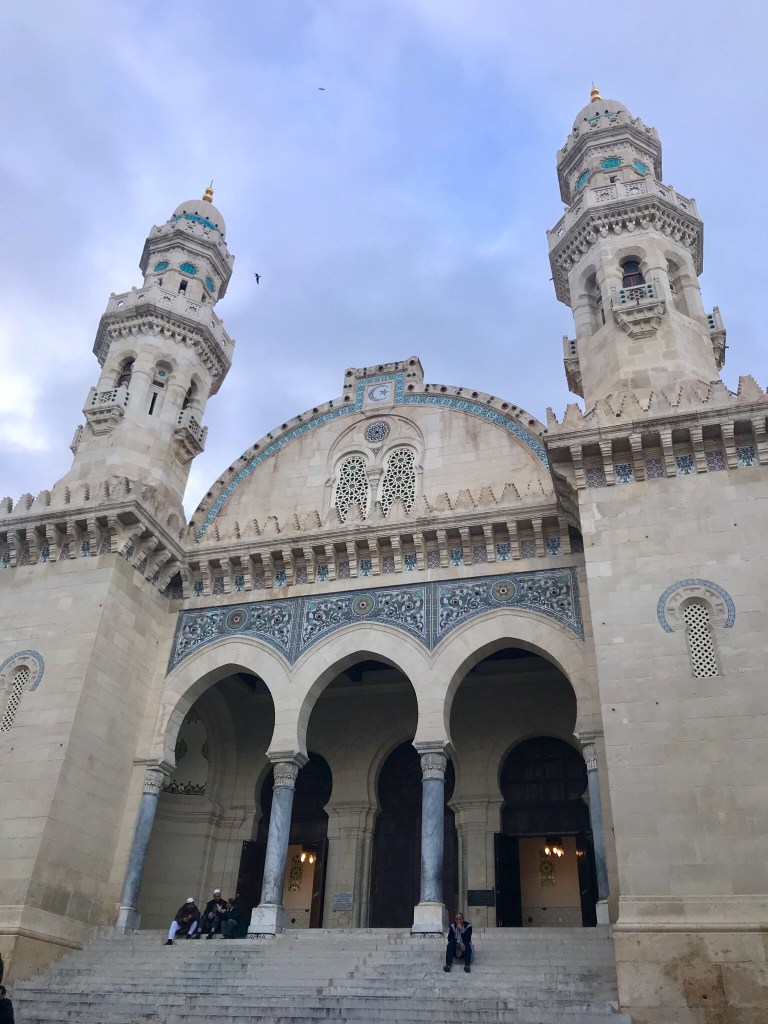
It’s the end of a sunny and warm December morning. Behind me is the crowded Martyrs’ square buzzing with street vendors, and in front of me is the famous Ketchaoua mosque with its outstanding fusion of Moorish and Byzantine architecture.

Ketchaoua mosque – built before 1612 during the Ottoman era.

I’m standing in the middle of the street, with an almost empty handbag, listening to the call to prayer echoing from the surrounding mosques and watching worshipers flocking the Ketchaoua doors.

I can feel people looking at me strangely. It’s clear I’m not from the area and they are probably wondering why I’m standing here, at the foot of the Casbah of Algiers, with one leg to the front and another to the back.

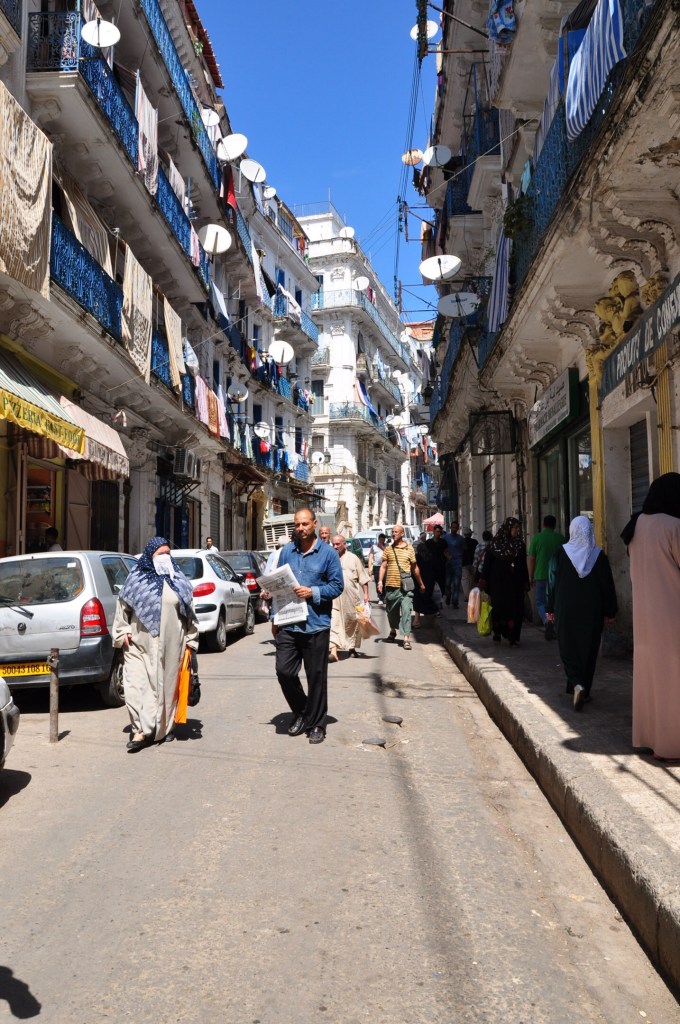
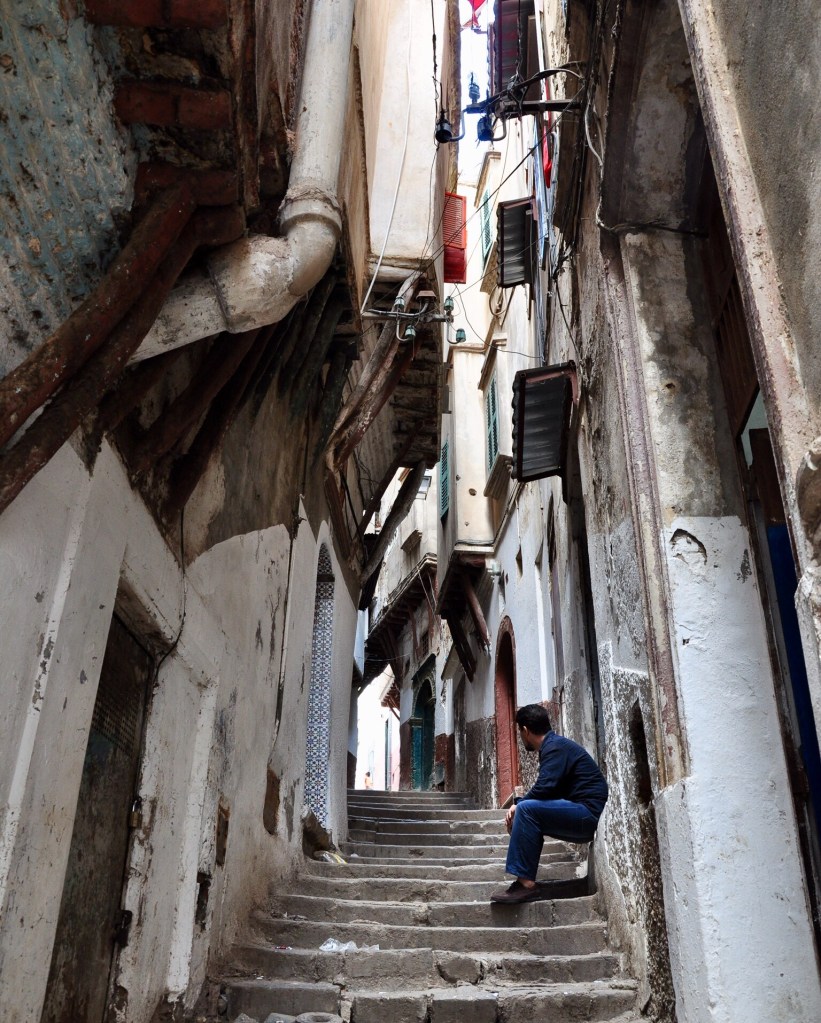
A street in the lower part of the Casbah.

It’s been over 10 years since I last set foot here. At the time, I visited the Casbah with my parents as it wasn’t considered safe to go there alone, but today I want to explore it by myself. I want to see what has become of this old quarter of the city.

Martyrs’s square

The Casbah of Algiers is the oldest quarter of the city, nestled on top of a hill with white washed houses overlooking the Mediterranean sea. It has been an unsafe quarter for tourists and locals alike for decades during the civil unrest in Algeria – pretty much like the rest of the country, but has recently started reshaping itself with various renovation projects and guided tours.

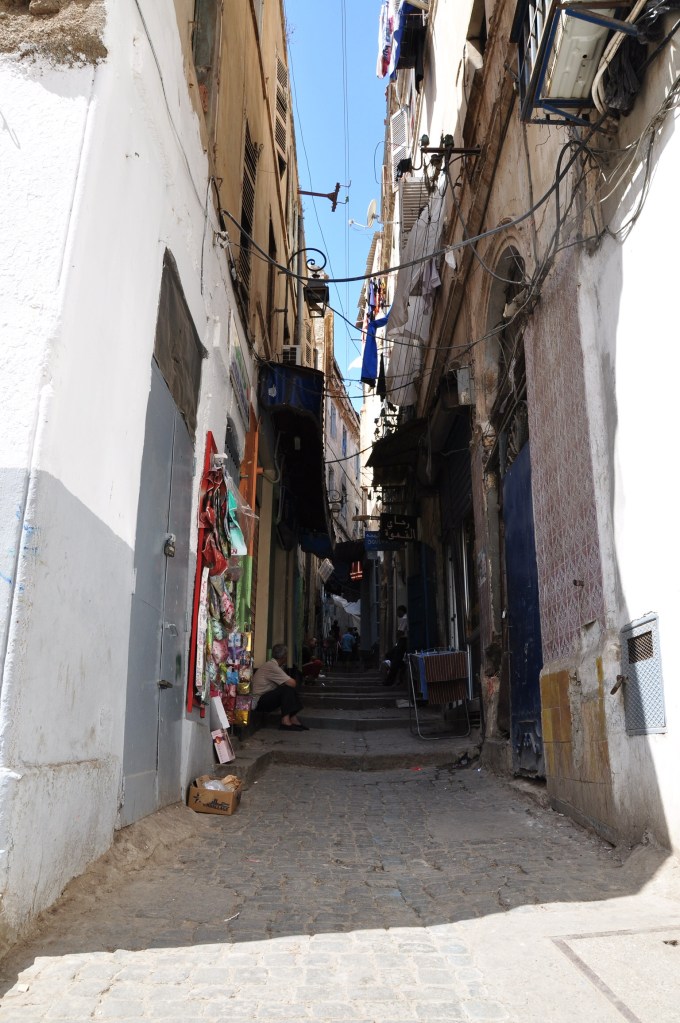
An alleyway in the lower part of the Casbah.

El-Casbah, as the locals call it, is full of historical and religious sights. A walk through it feels like a journey in the past. It’s been inhabited since at least the 6th century BC by the Phoenicians and has been the heart of the capital since the Ottoman era as seen from the plethora of palaces and mosques scattered across its alleyways. During the Algerian revolution against the French occupation, it played an essential role as a base for planning and hiding.

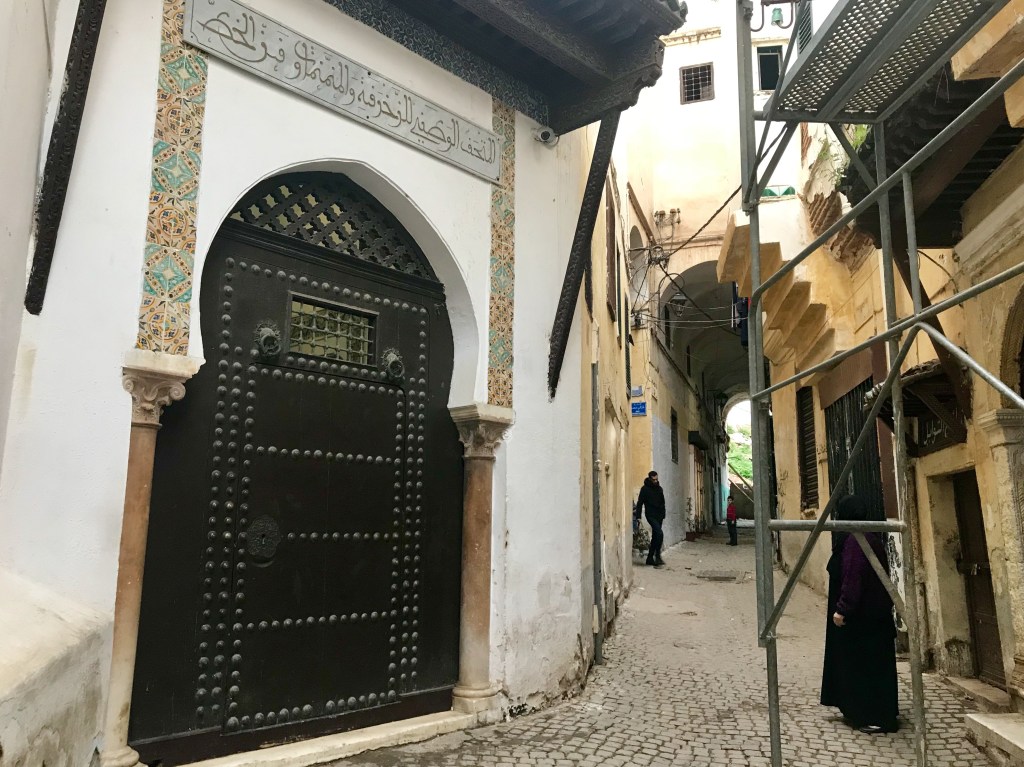
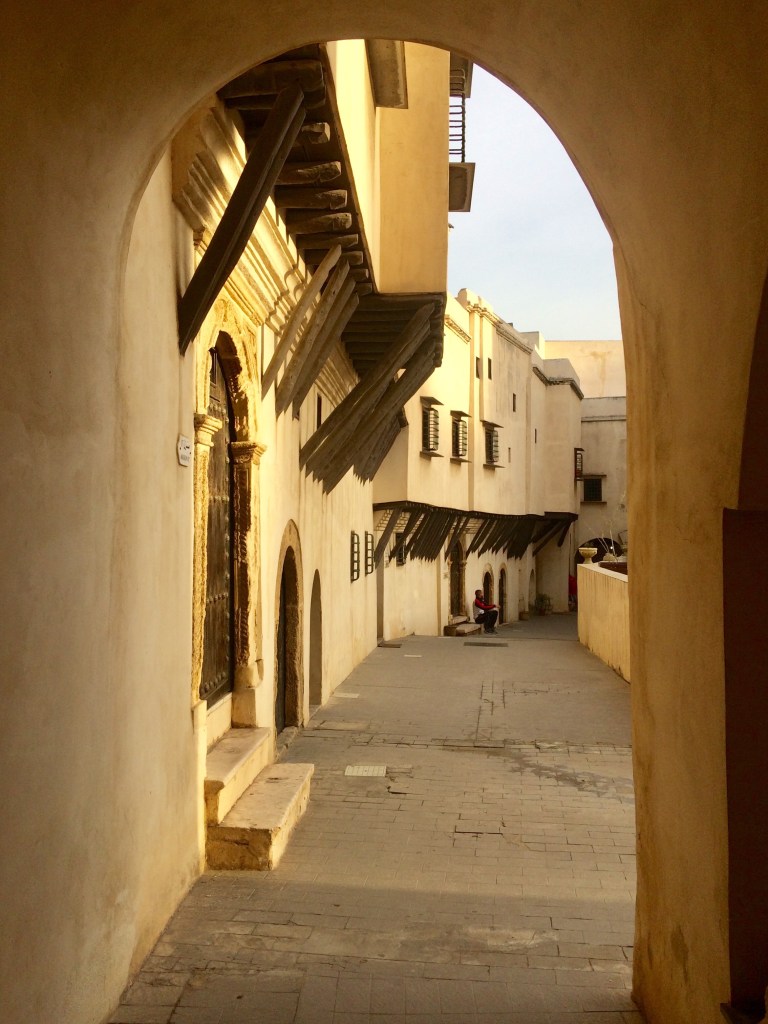
An old Ottoman palace converted into the museum of miniatures and calligraphy.

I start my walk in the lower part of the Casbah, which has a number of ancient Ottoman palaces like Dar Aziza and Dar Hassan Pacha – all within a short walking distance from each other. They were built in the 16th and 18th centuries by the Deys and Pachas of Algiers, and have very similar moorish architecture, which dominated the region at the time.

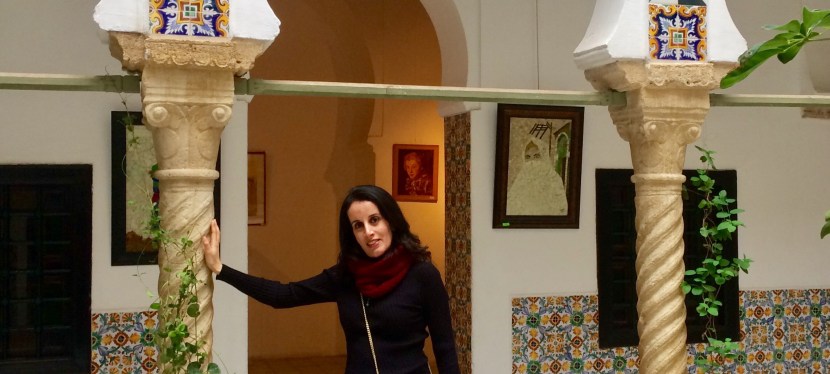
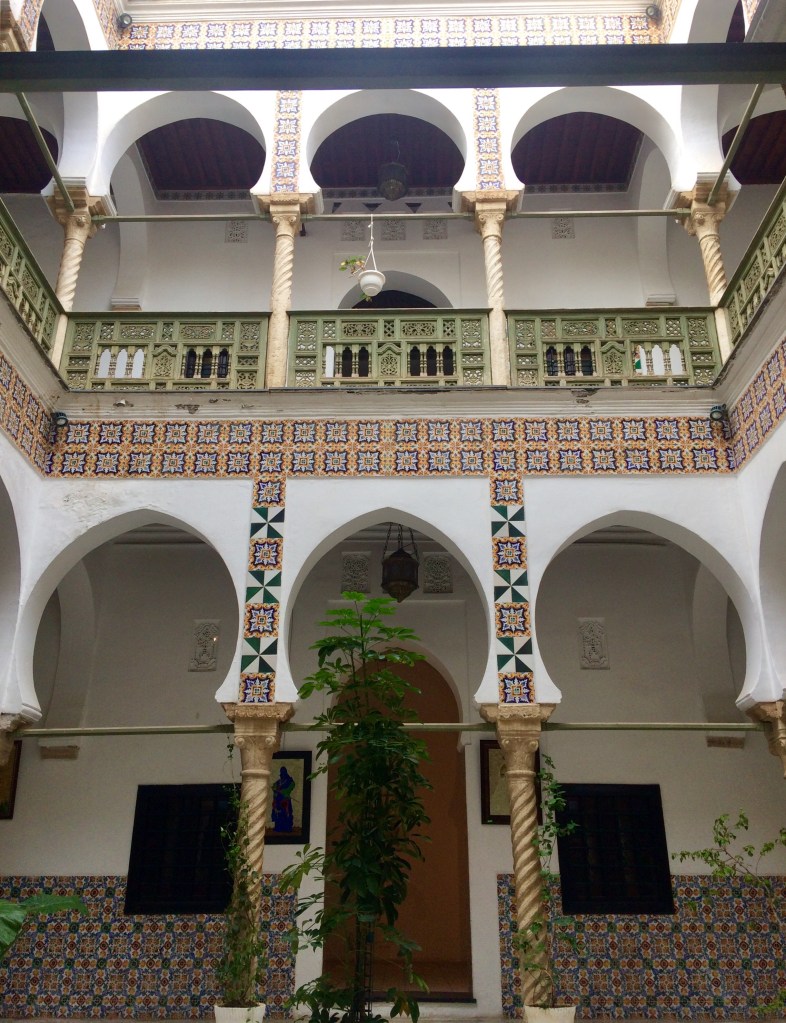
In the centre of each palace is a marble courtyard with a fountain in the middle to keep the house cool during the hot summer days. The rooms are split across two floors surrounding the courtyard, and the walls are decorated with different types and colours of faience that give each palace a unique style.

Dar Mustapha Pacha alone is covered with more than 500000 Italian and Dutch faience mostly coming from Delft in the Netherlands. Dar Khedaoudj el-Amia, which was originally the palace of Ahmed Rais then the home of Hassan’s Pacha daughter, is now home to the national museum of arts and popular traditions.

Inside the palace of Mustapha Pacha.

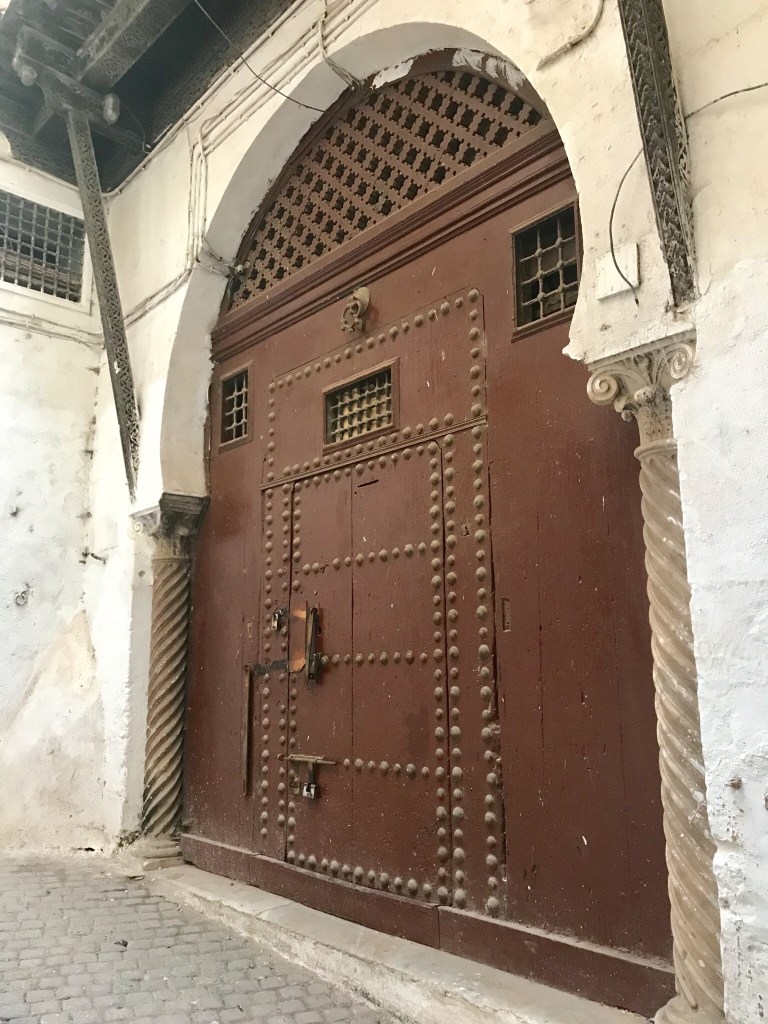
As I was admiring the grandeur and style of a wooden door in one of the alleyways, I suddenly hear someone asking me “Do you know why the knock handle is so high up?”. “No” I reply. So, he continues “during the Ottoman era, the nobles used horses to go around. So, to avoid getting off their horses to knock on doors, they placed the knock handles high. You can also see that there is a large and a small door – the large one is for people coming on horses”.

An Ottoman-style door of one of the old palaces.

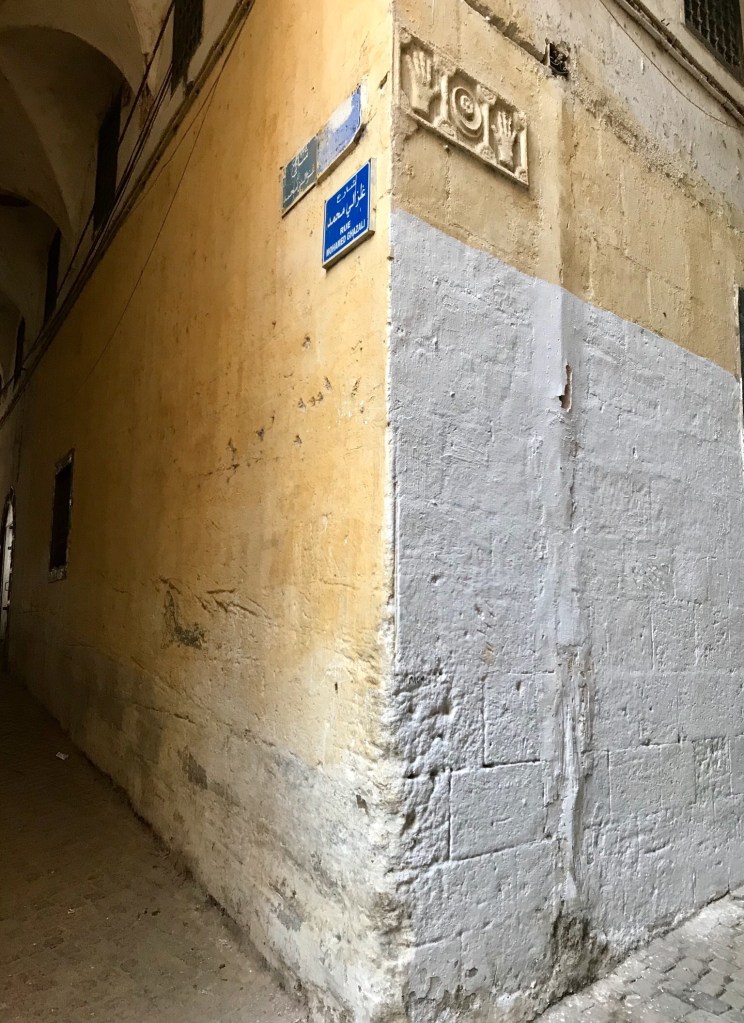
The man then walks few steps towards the end of the alleyway and points at a sign with two hands carved in the top corner of the wall explaining that it was used to mark the streets inhabited by Muslims. It’s amazing how people here are very eager to share information about the history of the place, their struggles and the way they live.

The sign at the top corner of the wall was used to mark the streets inhabited by Muslims.

From the Ottoman era, I move to a more recent period of the Algerian history. I’m now in front of the museum of Ali la Pointe, located in the middle part of the Casbah, which was the house where four famous freedom fighters got blown up during a raid of the French military, as they refused to surrender.

The entrance to the museum of Ali la Pointe with the painting of the four martyrs on the side.

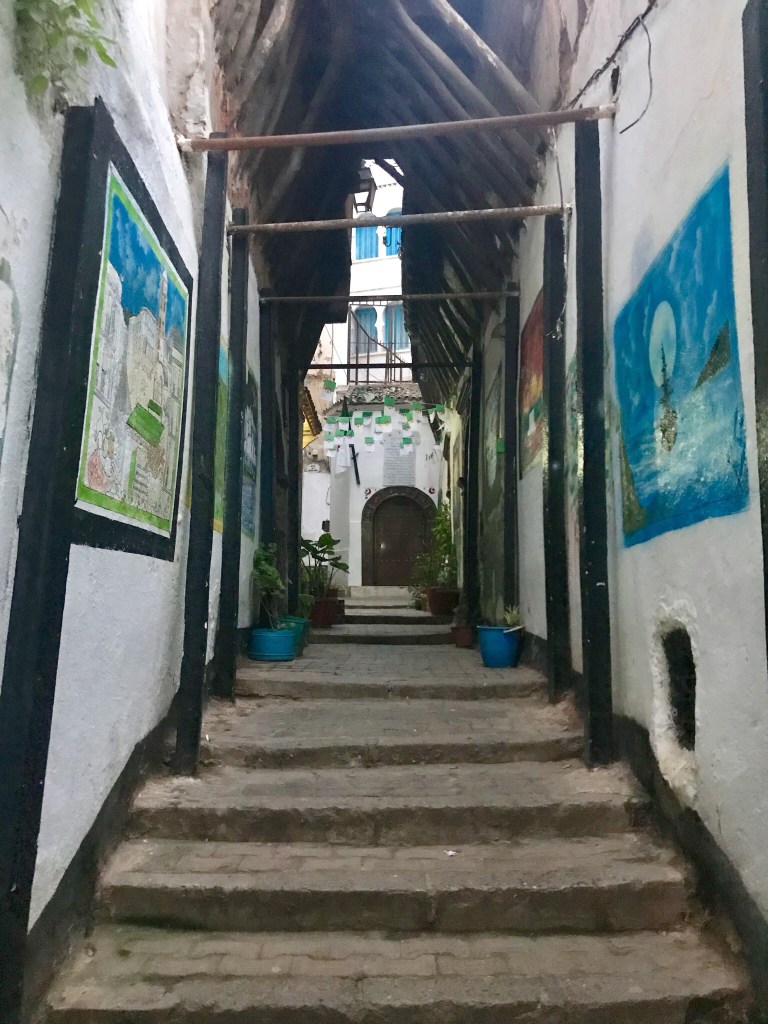
The alleyway leading to the museum is decorated with colourful street art and Algerian flags including a painting of the four martyrs. As I look around, I get flashbacks from the famous Gillo Pontecorvo’s 1966 black and white movie – the Battle of Algiers, which was shot here and is a true recreation of the Algerian uprising against the French occupation.

The alleyway leading to the museum of Ali la Pointe.

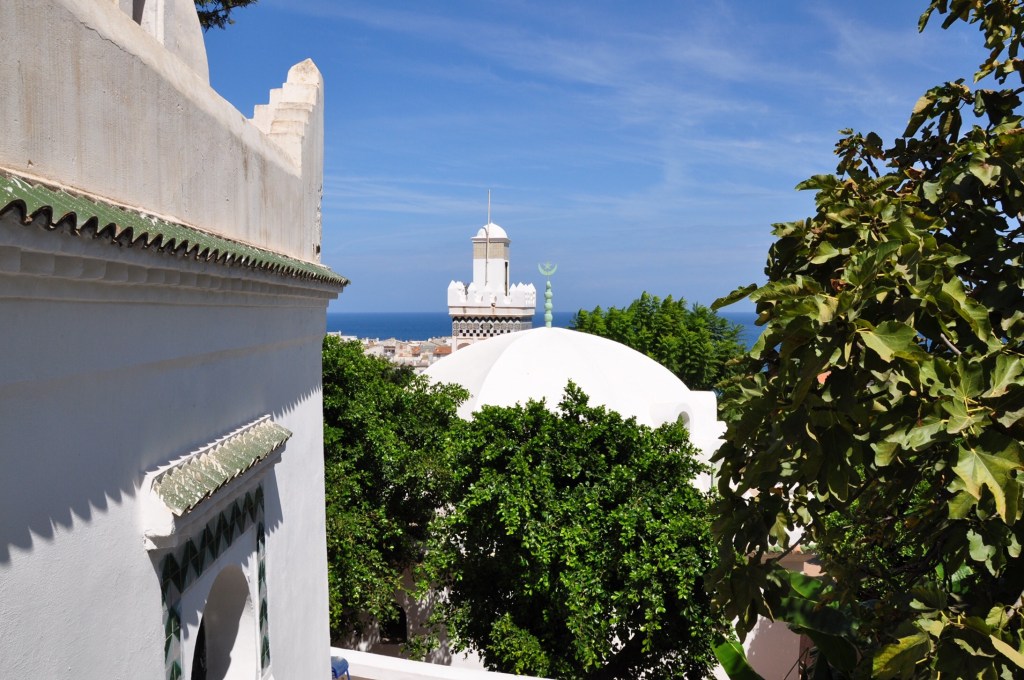
My next stop is Sidi Abdarrahmane mausoleum, which is a mosque, a mausoleum and a graveyard where some very notable people have been buried including patron saint Sidi Abdarrahmane. It was built in 1696, and today it’s a place of worship and spiritual connection. The view from here is breathtaking with the mausoleum’s white dome and minaret, emerging from behind the trees, overlooking the blue sea and clear skies.

The view from Sidi Abdarrahmane mausoleum.

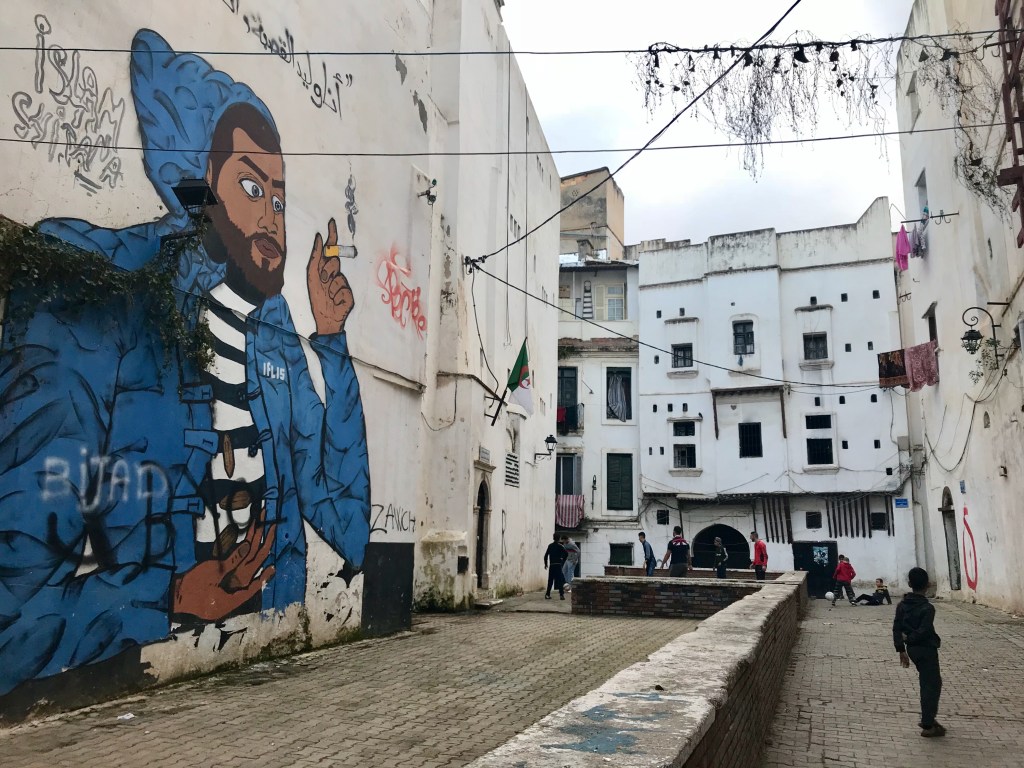
It’s now mid-afternoon. The streets are not very busy in this part of the Casbah, apart from the men sitting by their front doors watching passersby, kids playing football in a courtyard and a group of men playing dominoes.

Kids playing football in one of the courtyards.

The afternoon here seems to be long and enjoyable. Someone once told me “In Europe, you have watches, in Africa we have time”, and he couldn’t be more right as you can clearly see people here enjoying the slow movement of the day.

A man sitting by his front door enjoying the quiet afternoon in one of the alleyways.

I continue to walk up the alleyways until I reach the Palace of the Dey at the top of the Casbah, which was completed in 1596 and was once the second largest palace in the Ottoman Empire. During the French occupation, it served as a military base for the French army. As much as I want to spend more time strolling through the alleyways of the upper Casbah, I need to head down to Bastion 23 (Palais des Rais) before it closes.

Bastion 23 is a magnificent historical monument with three palaces and five fishermen houses, built in 1576 by the famous corsair Barbarosse. A walk around it gives an evocative insight into how the Deys and corsairs lived during the Ottoman era.

Fishermen houses inside Palais des Rais (Bastion 23).

“If it wasn’t for a group of people who sponsored its renovation, this palace wouldn’t exist today” tells me one of the guards. The monument is indeed well refurbished compared to the other palaces and certainly the alleyways I walked through earlier today.

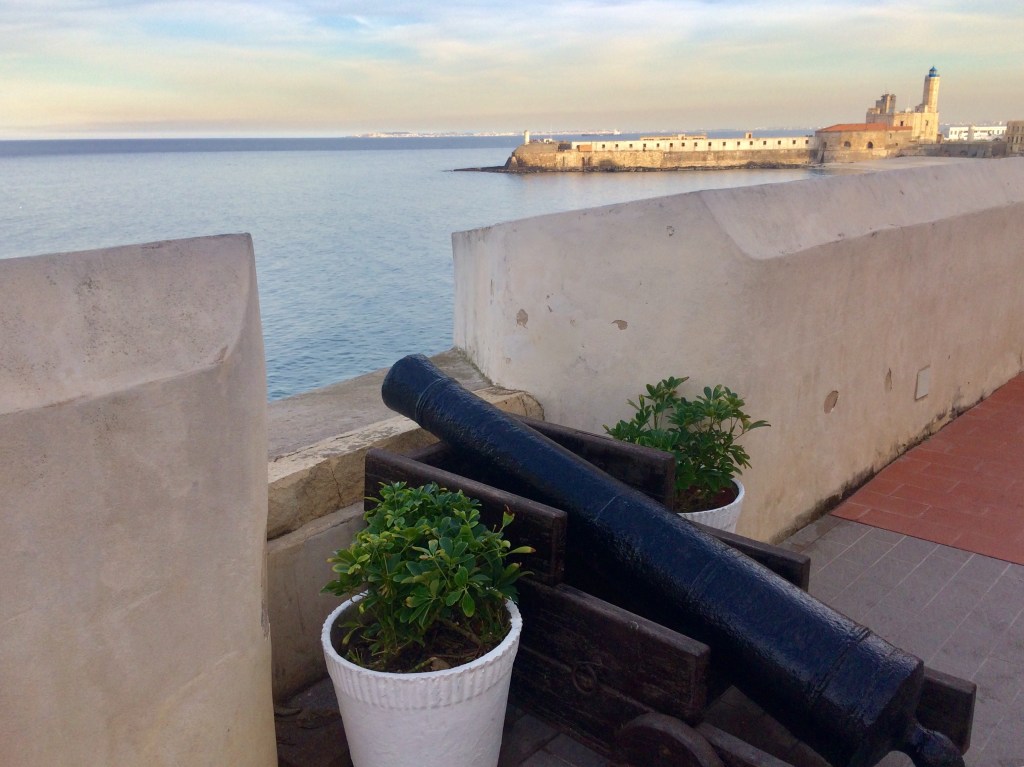
Inside Bastion 23 (Palais des Rais).

As I step into the terrace overlooking the blue sea, I see the canons surrounding its walls and start to picture how this place looked back in the 17th and 18th centuries when Algeria had one of the most powerful and feared fleets in the Mediterranean.

Bastion 23 (Palais des Rais) courtyard.

As I leave the Casbah behind me and start walking along the bay, I suddenly wake up to the sight of a beautiful sunset settling down in the horizon. I stare in awe and wonder if this place will ever be buzzing with tourists, or will it continue to be a destination for the daring ones who want to travel through its memory lanes and enjoy its unspoilt beauty.

Or, will it be for people like me who want to explore the homeland they once left behind. After all, this trip may not have been to satisfy my curiosity of what had become of a place I visited a long time ago but most probably to settle the feelings of nostalgia from self exile.

Bay of Algiers at dusk.